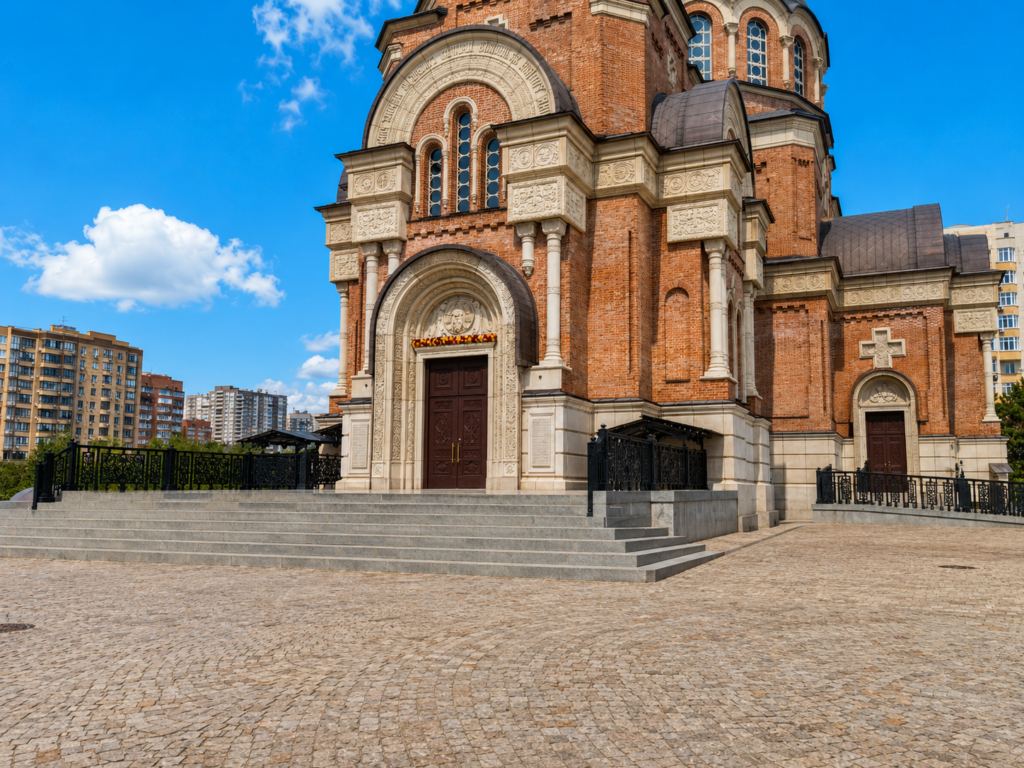
On the Don land, in the ancient farm Obukhovka, there is a temple, which locals call nothing but saved. A century and a half of storms, wars and persecution have failed to extinguish the lamp of his faith. Built of red brick, with a lace white stone bell tower, aimed at the sky, it remains the heart of the district today. The secret of his resistance is not in the thickness of the walls, but in people who are ready to spend the night on the cold floor, protecting the shrine.
The history of the Transfiguration Church began in 1861 with the petition of the Cossacks of Elisavetovskaya Stanitsa. Ataman Mikhail Khomutov personally asked Archbishop Donskoy to bless the construction of a prayer house. The funds were collected all over the world, selling fish and grapes. Already in August, the place was consecrated, and by 1864 the temple was erected. At first it was half stone, with a wooden top and a single throne. The temple grew gradually: the southern chapel in honor of Andrew of Crete was built by 1890, the northern one — in the name of Saints Constantine and Helena — four years later.
The appearance familiar today, the building acquired by 1913. Rostov architect G.N. Vasiliev designed a four-tiered tent bell tower, and it became a genuine decoration — a multi-tiered tent seems to hover over the farm, permeated with openwork decor. The cross-shaped four is crowned by a powerful light drum surrounded by four miniature bulbous heads. The style gravitates to pseudo-Russian motifs, but it is not the hand of the Moscow academician that is guessed in it, but of folk masters who invested in the masonry of the Cossack thoroughness and warmth.
The inner space is matched by the outer greatness. As soon as you cross the threshold, you find yourself in the world of restrained painting, where deep blue, emerald and golden tones dominate. The center of attraction is a three-tier carved iconostasis. He managed to protect in the dashing years thanks to a simple trick: the locals painted the gilding with bronze paint, hiding the radiance from the eyes of militant atheists. The temple has preserved ancient images and a heavy panic, whose candles remember the prayers of several generations.
The fate of this temple is truly exceptional. In 1940, officials issued a closing verdict accusing the community of failing to comply with formal arrangements. But the Cossacks died. The Chairman of the Church twenty Grigory Nazarenko organized round-the-clock duty, for which he paid with freedom — eight years of camps under Article 58. The parishioners with the children locked themselves inside, refusing to leave the shrine. In the face of such determination, the godless power retreated. They say that during the most severe floods, the water that flooded the farm, dutifully froze at the steps, not daring to cross an invisible line.
The war also spared the temple, although the walls still contain bullet and shrapnel marks. When the German scout climbed to the bell tower, the priest immediately crossed to Azov and reported to the headquarters. Fire was opened on the temple. Broke the glass, damaged the fence, but the bell tower stood. Today, the bell tower is no longer sentry, but bell ringers, and the raspberry bell floats over the free Don steppe.
Since the mid-1980s, the appearance of the shrine has been constantly updated here: the roof was blocked, heating was carried out, ancient frescoes were cleared. In 1990, the temple was crowned with new domes. And in one of the aisles a real miracle happened: late in the evening, the ponomar heard a wonderful singing and, entering, saw how the masking paint came down from the arch above the royal gates by itself, revealing pure gold to the eye. There is no doubt that this was a sign from above.
The Temple of Transfiguration is full of life today. Under its vaults pray the descendants of those heroic Cossacks who once defended the house of God at the cost of their own freedom. And it seems that the very air here is saturated with history, in which human courage is intertwined with heavenly intercession into a single pattern — durable as the Don land.
Charity FundHoly Land.
Russian Temples and Monasteries