1220. Princely strife. The Grand Duke of Ryazan Ingvar Igorevich fought off the army of his cousin Gleb and, in gratitude for the victory, decided to found a monastery. The place was chosen on the banks of the Oka River, near the town of Lgov. The monastery was also opened, 300 boyars and 600 vigilantes were present. The prince of the monastery gave generously — 9 side lands, 5 ghutorki. Cells were built for the brethren and a small stone temple of the Assumption of the Most Holy Mother of God. The monastery did not really blossom — the Mongols came. Burned the monastery to the ground.
The monastery was revived by the Ryazan prince Oleg Ivanovich in the 70s of the 14th century. He rebuilt the premises and gave the land. Therefore, the monastery began to be called Olga (from the Russian version of the name Oleg – Olga). But again, it was not the fate of the monastery to flourish. After the death of the prince, the monastery faded and was attributed to a larger monastery — Savvino-Storozheskovskiy. The certificate was signed by Tsar Alexei Mikhailovich in 1651. By this time the stone church had collapsed. It was renovated in 1666, new chapels were built.
By the beginning of the 19th century, the land from the monastery was taken, and he completely withered. Its closure was seriously considered. This was prevented by the local landowner Nikolai Zakharovich Apukhtin. At his own expense, he renewed the buildings and erected the Trinity Church and a two-storey building for the brethren. The efforts of Nikolai Zakharovich paid off: in 1858 in the chapel of the monastery there was the appearance of the Iverian Icon of the Mother of God. Thanks to this icon, many miracles were performed, about which detailed records were kept in the monastery. Unfortunately, they have not survived.
Even with the wonderful icon of the inhabitants in the monastery there were so few that in 1896, Archbishop Justin of Ryazan appealed to the Synod with a request to transform the monastery into a women’s one. The archbishop believed that “women’s monasteries are higher than men’s.” The brethren were settled in the surrounding monasteries, and the abbess and 29 novices came to Olga Monastery.
By the October Revolution of 1917, the monastery had 2 churches. The first is the cathedral, built in 1666 on the site of an older one. It was a five-domed church with two chapels – Nikolsky and Palladievsky, with its refectory and majestic bell tower.
The second temple, the Holy Trinity, built in the early 19th century, also had 2 aisles. In one of them, the Assumption, the miraculous icon of the Iberian Mother of God was kept.
The monastery had a hotel for pilgrims and he succeeded. There even opened a women’s school named after Polonsky. Yakov Petrovich Polonsky was a famous poet, he was friends with Fet and Tyutchev. He was originally from Ryazan, and although the poet died in St. Petersburg, they buried him in the Olga Monastery. In 1958, the poet’s grave was moved to the territory of the Ryazan Kremlin.
After the revolution, the monastery functioned for some time, but in 1925 it was closed. The temples were destroyed. The fate of the miraculous icon is unknown. The premises were used as an orphanage, a nursing home, a commune. Finally, in 1972, a women’s educational colony for teenagers was opened here. The order in it is very similar to life in a monastery: a single form, a strict regime, a lot of work. The pupils take care of the greenhouse farm and study in secondary school. Currently there are about 300 students.
In 2001, a temple was opened on the territory. They dedicated it to the icon “Softening of Evil Hearts”. The temple is five-domed. The main dome symbolizes Jesus Christ, and the small ones symbolize his disciples. The same five-domed temple was destroyed after the revolution.
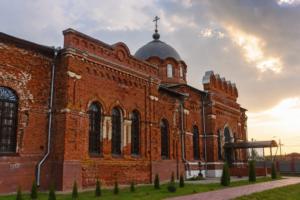
Little remains of the old monastery, but the stonework is still as strong as it was 200 years ago.
Charitable Foundation Holy Land
Russian Temples and Monasteries