People call this church Svirskaya. Either because it stood on the trade northern (Svir) road, or in honor of St. Alexander Svirsky.
The temple was built at the end of the 12th century, by order of the Smolensk prince Davyd Rostislavich.
The prince was distinguished by grumpy character, constantly participated in internecine strife. And would remain another petty prince, which no one remembers, if not for 2 events. The first is mentioned in the “Word of Igor’s Regiment”, again, about internecine strife. And the second – he ordered to build a very unusual temple in Smolensk.
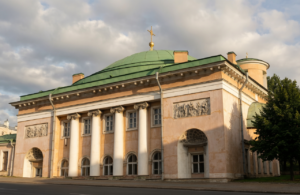
The Church of Michael the Archangel is not like the traditional Russian churches. This is a tower with 4 faces, it has 3 porches, from the north, west and south. They and the only apse on the east side recreate the shape of the cross. There’s only one dome in the building. At the base of the building are huge boulders. The walls are built of flat brick – plinth. Jars embedded in the walls,
The voices create an amazing acoustic effect. The singing of the choir acquires a special
Higher effect.
Imagine serving in such a church. At a time when people lived in semi-darkness, with scant light and cold-closed windows, believers would enter a temple full of light.
The chronicler mentions the wealth of salaries decorated with gold, silver and pearls, the painting of walls. It was breathtaking.
Unfortunately, only a few fragments remain of the frescoes, but even without them the temple is striking with the clarity of lines, amazing proportions, incredible acoustics.
The church survived the Tatar-Mongol invasion. It survived the invasion of Polish troops.
In 1611 it was transformed into a Catholic church. And after the return of Smolensk to Russia, she again became Orthodox. To do this, it had to be re-sanctified, which was done in 1654.
At 18, the temple was rebuilt — large windows were broken, walls were shifted in some places, the facade was decorated.
The building was surrounded by a stone fence and a bell tower was erected.
The room has also been transformed inside. There was more light, the interior decorations sparkled and shimmered. The temple was impressive. Smolyans loved him, came to worship even from distant ends. In 1812, the French took all they could out of the church. Even wooden
The decorations were used for wood.
But thanks to the support of Emperor Alexander I and the donations of the citizens, the Svir Church came to life again. Restored the interior, decorated the building outside.
Alas, in 1930, services were banned, and the premises were given to a military warehouse. The building was dilapidated. Good thing it wasn’t demolished. In 1963, the first attempt at restoration was made. Architect A.P. Baranovsky wanted to return the church to its original appearance. From the facades removed stucco and jewelry of the 19th century, updated masonry.
The second stage of restoration occurred in the 70-80 years. This time, attention was directed to the octagonal windows of the facade.
In 1990, the building was returned to the Russian Orthodox Church and stage 3 began — the restoration of the interior decoration. Work is still ongoing, but in 1999 the iconostasis and carved throne of the temple were consecrated.
Currently, daily services are held in the temple, there is a Sunday school.
Charitable Foundation Holy Land
Russian Temples and Monasteries