At the beginning of the 18th century, the Stable Yard was built near the canal, which is now named after Griboyedov. It was a whole complex of office and residential buildings for employees of the Stables Department. A temple was built for numerous workers and their families.
It was made of wood and was located above the gate. Services in the church began in 1737. Relics from Count Golovkin’s home church were transferred there: Icons of the Savior Not Made by Hands, the Sign, a shroud embroidered with gold and pearls and other church utensils.
In 1747, a stone church was built. The temple was decorated with a huge iconostasis, gilded and covered with patterns.
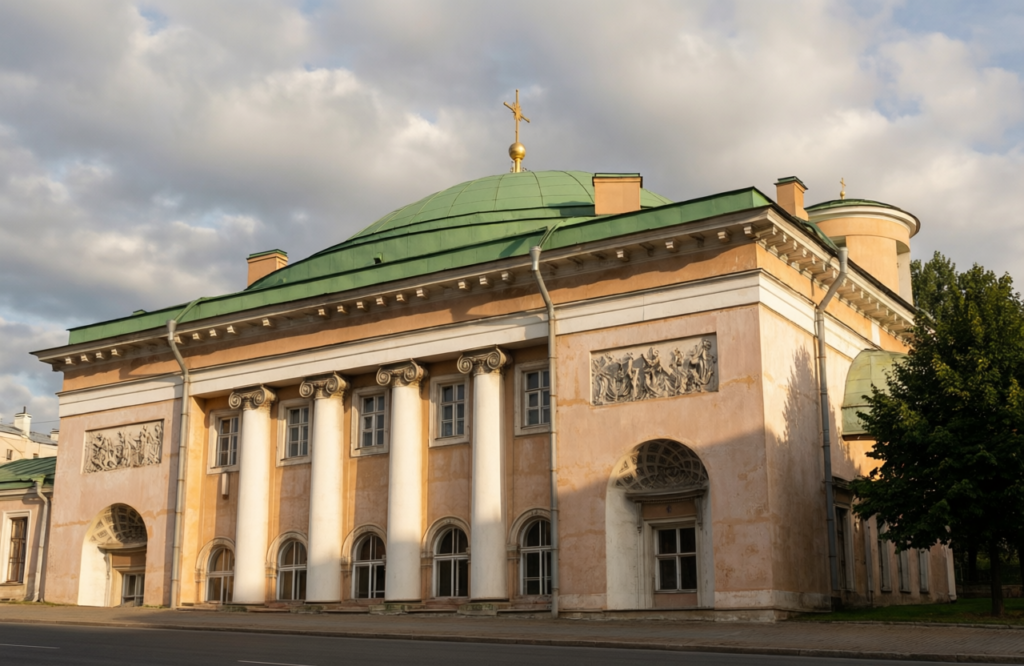
In 1823, the building was rebuilt again. Bas-reliefs of biblical scenes were placed on the façade. A whole team of artists worked on the icons for the carved iconostasis.
Light came into the temple from huge windows. One of them was yellow glass, creating the effect of sunlight inside the temple even on cloudy days. A huge chandelier, which shone with the light of more than a hundred candles, illuminated the church in the dark. Its height is 4 meters.

5 interesting facts about the church
1. Relics of the church: the shroud and icons were taken from Constantinople. How they ended up in Golovkin’s home church is unknown.
2. They say that the icon of the Savior was with the troops during the capture of Paris. This information has not been officially confirmed, but Nicholas I took the icon on his Turkish campaign.
3. After the duel, Pushkin was brought to the Volkonsky mansion. The nearest church was Konyushennaya. It was its rector, Archpriest Peter Pesotsky, who accepted the poet’s last confession.
4. The stable church was a court church; funeral services could be held there only with the permission of the court. Nicholas I gave this permission, despite the difficult relationship with the poet.
5. The composer Glinka died in Berlin, and in his homeland the funeral service was served in the Church of the Savior Not Made by Hands
In the mid-19th century, the temple was rebuilt again. It was expanded, windows were added, and the wall paintings were updated. And in 1916, the throne was decorated with expressive silver bas-reliefs.
For some time after the revolution, the temple existed, but in 1923 it was closed and valuables were confiscated. Couldn’t find them. Until 1990, the building housed mounted police.
Then the church was returned to the Russian Orthodox Church. There, internal and external restoration was carried out, and an exact copy of the bell was made at the Baltic Plant. The chandelier that had been taken to the Admiralty was returned. The iconostasis was restored.
The church is active, services are held daily. Every year on February 1, a solemn memorial service for A.S. is held in the church. Pushkin.
Charitable Foundation Holy Land
Temples and Monasteries of Russia