This place is extraordinary. Located 50 km from Pskov for 500 years, it brings the spiritual light of Orthodoxy to the lands bordering with Catholics.
5 unusual facts about the Assumption Monastery
Fact 1— The house was founded 2 times.
The official date of foundation is 1473. This year, in a sandy hill, a missionary – a priest, and later a monk, Jonah dug a cave and built a temple of the Assumption of the Most Holy Mother of God in it. But before that, two peasants cut down the forest and, having uprooted one tree, found the entrance to the cave with the inscription “given by God” (built). Local legend says that there lived a small community of monks from the Kiev-Pechersk Lavra. Whether they were saved from Tatar raids, or were conducting missionary activities, is unclear. We have only one name, the monk Mark. Nothing more is known about that community. But the founder of the monastery, Jonah, has information.
He was a priest and came to Livonian lands as a missionary. I came with my wife and children. He preached a lot to the Estam, Setu, Finns. He built the Assumption Church in the cave, and a monastery was formed around it. Before his death, his wife took tonsure under the name Vassa. After her death, Jonah (at that time John) also took a monastic rank.

Fact 2The monastery has never been closed.
The history of the border monastery is a chain of endless attacks, fires, looting. However, the monastery remained active for 500 years of its existence.
The monks believe with all their heart that the Most Holy Mother of God defended the monastery. At the end of the 15th century, the Livonians attacked the border. They began to rob the monastery, broke into the Assumption Church. Here from the altar on them blazed with flames that scorched eyebrows and beards. They were terrified.
In 1581, the Polish king Stefan Batory went to war on Russian lands. The monastery was captured by a large detachment. And behind the monastery walls were hiding three hundred streltsy, yes monks. The enemy did not just attack, the walls were fired at first. One of the cores made a breach in the wall, the enemy rushed into it and … nothing. They’re fighting in the hole, but they can’t get in. The attacker was not aware that the monks used their main defense: the icon of the Assumption of the Most Holy Mother of God. It was brought into the opening and the enemies could not overcome this defense.

The king ordered the siege to be lifted because the plans were to capture Pskov. The Poles had already captured Polotsk and Pskov, it seemed impossible to stand. But it just seemed like it. From the Assumption Monastery, 2 icons were sent to the Pskovites at once: “Dormition” and “Tendering”. The siege of Pskov continued for 5 months, but the city could not be taken.
Tsar Peter understood the strategic importance of the monastery. In 1701, a moat was dug around the walls and protective bastions were erected. Not for nothing. In 1703, thousands of Swedish troops tried to break into Russian lands. But a monastery stood in his way. The battle was long and hot, but the mistress did not leave the army and brethren, the monastery resisted. And soon peace was signed, the border was moved to the West and there was no one to defend themselves from. Or so it seemed before the Patriotic War of 1812. The French went to Pskov. Once again, as in earlier times, the inhabitants of the city called for the help of the Virgin. From the Assumption Monastery again brought icons of the Virgin. Once again, the city stood.

Fact 3During the fascist occupation, the monastery carried out incredible work to supply food to starving citizens in Pskov and Polotsk. The abbot managed to transfer food even to the camp of Soviet prisoners of war near Pechora. As part of the Pskov mission, the brethren not only helped with food and clothing, they also conducted missionary activities, visiting hospitals and schools, telling about the Lord and his graces.
Fact 4The monastery managed to recover the stolen treasures.
Retreating, the fascists took with them all the church utensils, salaries, some icons. But after 30 years, they were returned. Such a state does not always succeed, but here is a separate monastery, in a state that did not encourage religion, achieved the return of stolen property. Isn’t it a miracle?
Fact 5– the viceroy of the monastery became Patriarch Archimandrite Pimen headed the monastery from 1949 to 1954. He was later elected Patriarch at a local council in 1971.

Architectural complex
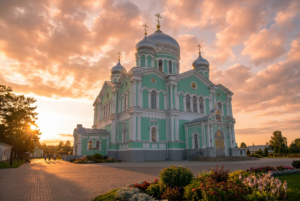
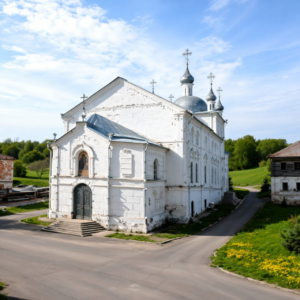
In addition to the God-created caves, there are several temples in the monastery. First Church,Assumption. It was from this that the history of the monastery began. The back of the temple rests on the mountain. It was later built over it.PokrovskayaThe church and now they share a common facade. Heads over the temple were erected in the 19th century.
Nikola Goalkeeper’s ChurchIt served as the Holy Gate, the main entrance to the monastery. Now it shares a roof with the Nikolskaya tower, but it was not always so.
In the belfryover 30 bells. It is one of the largest collections of bells in Russia. Large bells weighing up to 2 tons. Legends that they were sacrificed by the Russian tsars: Ivan the Terrible, Boris Godunov and Peter 1, are not true. All the bells were cast later, in the 18th century.
The largest building of the monastery —Michael Cathedral.It was built in honor of the liberation from Napoleonic troops. Salvation for Pskov came after the procession with the icon of the Mother of God “Tenderance”.
Sretensky churchIt was converted from the former refectory in 1870. It is believed that the foundation of the 16th century has survived.
InriszniaChurch utensils, vestments of priests, gifts to the monastery are kept.
There are 2 holy springs on the territory.
At the monastery there is a pilgrimage service, hotels for pilgrims, refectories are open.
Charitable Foundation Holy Land
Russian Temples and Monasteries