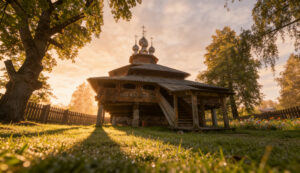
When we hear the word “Kizhi”, we imagine this church – the temple of the Transfiguration of the Lord. This building is considered the pinnacle of wooden architecture, a structure that absorbed the centuries-old experience of Russian builders.
What are its characteristics?
The cruciform plan is typical of 18th-century Russian churches, but what is unusual is the lack of a front entrance. From whichever side you do not come — everywhere excellent finish and amazing skill.
The building is cut down dry, there is no moss pad between the logs. 22 chapters is a rather unusual architectural solution, but it reflects the main mood of the 18th century — the desire for splendor and elegance.
The drainage system and the architectural forms themselves created a unique water protection, the preservation of the church eloquently testifies to its effectiveness.
The choice of wood for construction, the way it is processed, suggests that the architects understood the properties of wood and knew how to use them. For example, the heads are covered with aspen lemech, a traditional Russian tiles. Wood at the aspen does not give cracks, is easily processed and eventually acquires a mirror shine.
All the work was done with an axe, without using nails. There is evidence that wooden gels were used on the roof, which were later replaced by nails.
For 300 years, the Transfiguration temple was repaired many times. At the beginning of the 19th century, the church was sheathed with a tesse, and the heads were covered with tin. By the end of the 19th century, it was repainted several times and trimmed inside and out.
The most significant restoration work was carried out in the 50s and 80s of the last century. The first time got rid of the iron upholstery of the roof and tess, and the second – strengthened the building from the inside with a metal frame.
In 2009, the modern stage of restoration began. It is based on a unique method: restoration or replacement of logs without dismantling the building. The necessary log is removed, supporting the walls with jacks, and after restoration, inserted back. The gilded iconostasis was returned to the temple, it was kept in the museum for 40 years. All icons are arranged as indicated in
Archival documents of the 19th century. All wooden carved elements of the iconostasis have survived, despite their venerable age. They decorated the iconostasis at the end of the 18th century, and they miraculously survived.
After 11 years of continuous work, the restoration was completed in October 2020.
Charitable Foundation Holy Land
Russian Temples and Monasteries