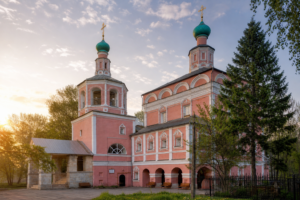
The beautiful ancient temple is called “on the moat” to distinguish the kgo from another Pokrovsky temple “under the mountain”.
That the ancient temple is confirmed by the fact that in the first written mention, from 1626, it is already called “ancient”. The building was wooden, and survived, despite the terrible fire of 1622, when literally the whole city burned down.
In the inventory of the city from 1685, the church is mentioned as still wooden, but soon after that all the temples of Kaluga began to be replaced by stone ones. Local sources say that the church was built in 1687, but in some accounts, it is listed as 1685.
The whole appearance of the temple suggests that it was built under the influence of Moscow architects. This is a crowdless four, which is so often found in the guise of the temples of Moscow. The Intercession Church is distinguished by a huge number of stone jewelry. Cashboards of windows, design of corners are made in a traditional manner for Russian architecture.
The temple is five-domed, all over the perimeter is decorated with a rich gaze. Another distinctive feature of the temple is the presence of voices. These are clay jars that were walled in walls. They amplified the sound, making it richer. The secret of voicemails is lost and in temples of the 18th century they are no longer used. The bell tower is low, but very beautiful, with two lower tiers.
In 1894, a miraculous icon appeared in the church — Mother of God Petrovsky. It was presented as a gift to the parishioners of the church, Sapozhnikov merchants. The day on which it happened, November 22, was celebrated as a church holiday until the church closed in 1930.
While the church was closed, it was used as an incubator. Although the exterior walls have been preserved, the interior decoration has suffered enormous damage. On the eve of the collapse of the USSR, the building was transferred to the music society. Repair work began there, which was planned to be completed by 1995. But the year before, the building was returned to the RCP.
There were no funds for repairs at the parish, and the abbot, with several volunteers, did all the work himself. All of them were very eager to start the services as soon as possible, but the archbishop blessed to write 2 icons before this event. The icon painting workshop was arranged right in the temple. And only when the images were ready did the first service take place.
Undoubtedly, miraculously, a fresco with the image of Kaluga saints has been preserved on the southern wall of the temple: Tikhon of Medina, Laurentius of Kaluga, Paphnutius of Borovsky. Above the entrance to the temple there is also a fresco of the Iberian Mother of God.
The temple was consecrated only in 1998, but by that time it already had a worthy core of parishioners who helped the restoration and undoubtedly considered the church “their own”.
Since then, the temple has been significantly transformed, its heads decorated with crosses, and on solemn days in the air rings its own bells.
Charitable Foundation Holy Land
Russian Temples and Monasteries