Thirty-seven kilometers from the city of Tula in the village of Venev Monastery there is an Orthodox women’s monastery with the same name. Located near the Venevsky highway and the river Sturgeon.
The church building was taken under state protection as an architectural monument. This is indicated on a special board of the monastery.
Officially, the first mentions in the chronicle belong to the XV-XVI century, but the monastery arose much earlier. The monastery is considered an ancient Russian building.
There are many beliefs associated with the monastery.
At the beginning of the XIII century, the priest Eustathius carried the icon of Nicholas and stopped at the Ostri River. Eustathius continued on his way, but left the disciple in the caves to preach Christianity among the pagans. A monastery was founded here.
In the XIV century, Sergius of Radonezh walked to Venev monastery and brought there the staff of the abbot. The path along which the Reverend walked was preserved.
In the XV century, Prince Yuri Smolensky in repentance spent the last years of his life in the Venevsky monastery. He repented for the murder of the spouses of Prince Simeon of Vyazemsky and Juliania, for which he had a love passion. He was buried in the monastery, with bequeathed money, new church buildings were built.

In the XVI century in the monastery where he was exiled, Pimen Black died. He was an archbishop of Novgorod and did not please Ivan the Terrible, because he advocated the independence of Novgorod. Pimen was imprisoned in a bag of stone and starved to death. His cell is still in good condition.
Close to the monastery there are caves in stone quarries, according to legend with monastic cells, from which there are passages under the ground. In Soviet times, the caves were blown up, but one entrance remained.
The monastery was part of different dioceses, subordinated to Ryazan, Astrakhan, Kolomna, Moscow. During the reign of Ivan the Terrible and Vasily Shuisky received rich possessions and lands. During this period, a stone temple was built in two floors with a bell tower.
In the eighteenth century, the situation of the church deteriorated. The monastery was abolished and turned into a parish church, many buildings of the monastery were dismantled.

In 1999, a women’s monastery was established, nun Alexia was appointed abbess. Restoration, construction, restoration of parts of the temple. Now ten novices live in the monastery. There is a farm: garden, cattle, garden.
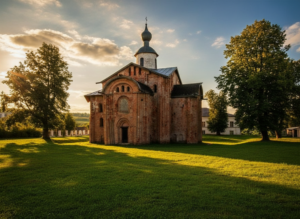
The temple was painted white, after restoration it was made red. The photographs show that the walls and ceiling of the monastery were decorated with plant ornament.
Near the monastery there is a cemetery where more than 500 spiritual people are buried. The graves of two elders are known: the priest Father Athanasius Reutov and the schiarchimandrite Christopher.
Venev Monastery is a historical monument of architecture of the Tula region, which attracts beauty, simple, but touching for the soul, history and interesting facts.
Charitable Foundation Holy Land
Russian Temples and Monasteries