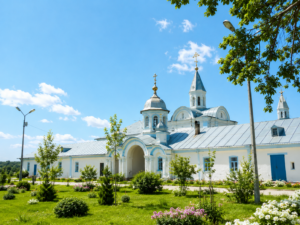
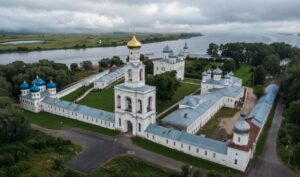
In the narrow passage between the majestic Assumption Cathedral and the ancient House of Bishops, a small one-headed church lurked like a guardian of another, secret life. This is the Archangel Cathedral of the Ryazan Kremlin. From the outside, he seems a humble contemplator against the background of lush neighbors, but if you step over his threshold, you feel yourself inside the stone chronicle, where every stone is saturated with the prayers of princes and the episcopal silence.
Initially, this cross-domed temple with three apses served as a house church of the Ryazan princes. Imagine the end of the XV century: here, in the light of the lamps, petitions for military victories were raised before the marching image of the Archangel Michael — the heavenly leader of the disembodied forces. Since then, the cathedral has protected not only the souls of the living, but also became a tomb for those who nursed the Ryazan land.
The walls of the temple remember everything. After the terrible fire of 1647, which turned the bishops’ court into ashes, the cathedral seemed to be tempered in fire and four years later it rose up renewed. However, time is more merciless than flames: by the middle of the XVIII century the building was so dilapidated that the liturgies here fell silent for sixty years. The silence was broken only by the echo of footsteps and the wind walking on empty vaults. The second life in the temple was breathed in the early XIX century, and by 1865 its appearance was decorated with a lush western portal and refectory in the pseudo-Russian style — this restructuring was carried out by architect Shchetkin at the expense of merchants Zhivago and Osminin, who left their mark in the revival of the shrine.
Passing under the vaults, you involuntarily lower your eyes to the floor. Somewhere here, at the right choir and on the eve of the altar, there are 22 burials of the Ryazan lords. Here lies the martyr Misail, killed by pagans in Shatsky district, and Archbishop Theodorit — the same one who in the turmoil of 1613 headed the embassy to the young Mikhail Romanov and persuaded him to accept the royal crown, marking the beginning of a three-century dynasty. And the most famous of those who died here is Metropolitan Stefan Yavorsky, a fiery preacher, Locum Tenens of the Patriarchal Throne, whose pen created the famous “Stone of Faith”. His brilliant mind served as a support for Peter I, but his heart remained forever chained to the Ryazan land.
Today, hymns are heard in the temple walls again. Having survived the devastation of the XX century, when priceless prayer images were lost — including the oldest icon of Paraskeva Friday 1147 — the cathedral did not lose the main thing: the sense of the indestructible connection of times. Now, among the vaults remembering the steps of Emperor Nicholas II, who came here to venerate the ashes of the hierarchs in 1904, the museum silence and live prayer are bizarrely intertwined. Standing in this place, you physically feel that history is not dusty dates, but a solid, centuries-old floor under your feet.
Charity FundHoly Land.
Russian Temples and Monasteries