

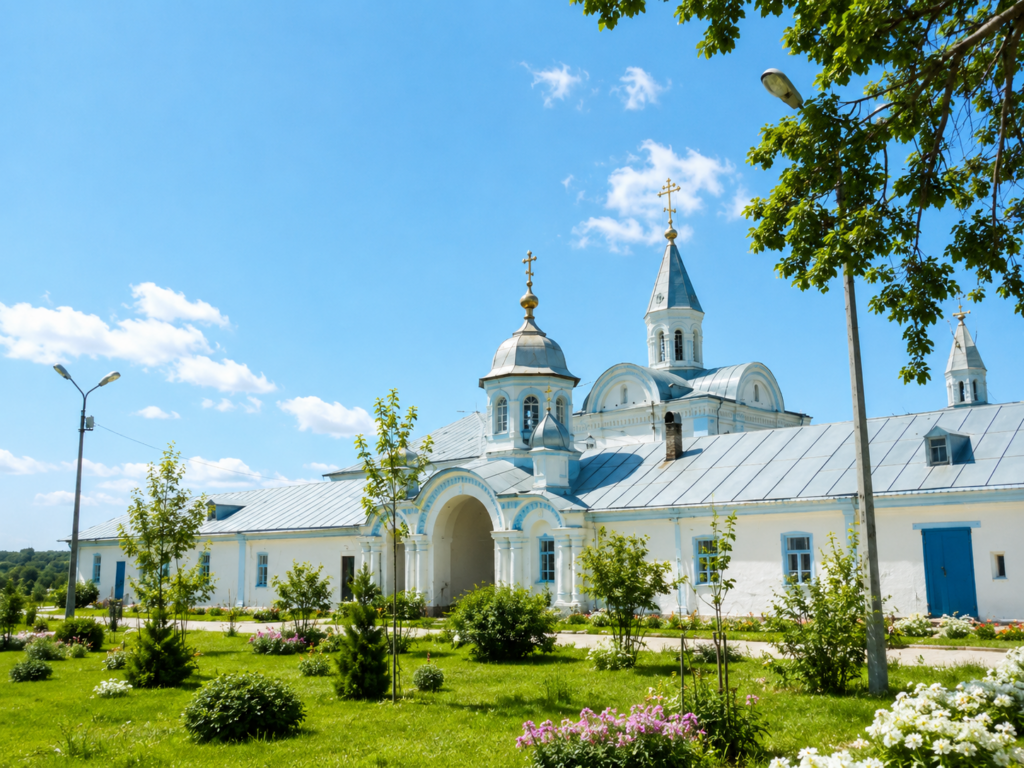
Quiet river Koryazhamka, winding among the northern forests, remembers the light foot of the monk Longin. In 1535 he left the Pavlo-Obnorsk monastery to, together with Simon Soyginsky, cut down a tiny chapel in the name of Nicholas the Wonderworker. No one could even imagine that this modest cell would grow a monastery, around which a young city of wallets would make noise centuries later. In the silence of the monastery walls, Longinus’s disciple, Christopher, also asceticized for a long time, who later went even deeper into the wilds to found his own desert. And compiled here in the 1620s, the “Saints” still serve as a silent argument in theological disputes about the veneration of Ivan the Terrible.
The monastery did not find stone breath immediately. Almost a century and a half, all the buildings remained wooden, and only in 1671 the five-domed Annunciation Cathedral with a tent bell tower rose above the river. Later, the ensemble was replenished by the strict Savior Church. However, the heyday turned into desolation: frequent changes of abbots and the neighborhood of many monasteries led to the fact that in 1863 the monastery was attributed to Solvychegodsky. The second breath was given to him by the merchant of the first guild Khaminov, who bequeathed forty thousand rubles with the condition of restoring independence. By 1913, the majestic St. Nicholas Cathedral with an octagonal belfry had grown here, and behind a strong fence were the bishops’ chambers, the bell tower and the chapel over the well, which, according to legend, was dug by St. Longin himself.
The revolutionary 1918 ended the life of the monks, and in the empty walls alternately ran collective farms, children’s commune and building trusts. The explosions of 1933 erased the Annunciation Cathedral and the bell tower from the face of the earth, leveled the holy spring, and for decades the ruins served only as storage dungeons. But the earth remembered prayer. In 1989, the ruins were handed over to the Orthodox community, and a painstaking resurrection began: sisters and volunteers cleared the rubble, searched for the mouth of the Longin well, re-erected domes above the gates.
Today’s monastery is a living testimony that holiness does not sink into time. The overlay chapel meets the pilgrims again, the bell rings over Koryazhemka, and the water found in the ancient well is still as cold and clean as on the day when St. Longinus first folded his hands here for prayer.
Shrines
Orthodox relics are kept in the temple: the creeds and the hairdress of St. Longin of Koryazhemsky, the founder of the monastery.
Charity FundHoly Land.
Russian Temples and Monasteries


