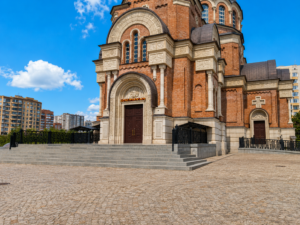
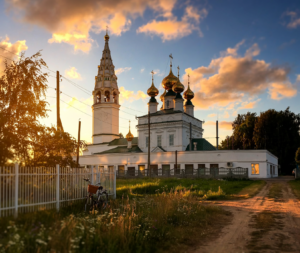
A quiet corner of Udmurtia, the village of Mozhga, hides a building, whose becoming makes the heart freeze. A tall dome hovering above the four can be seen from afar. This is not a guest from dusty textbooks, but a living organism that remembers the creaking of carts and the hum of the war years. Before us, the Kazan-Theotokos Church is a story carved in stone by the genius of S. E. Dudin.
It all began in 1751 with the opening of the parish. The first wooden structure did not last long, giving way to a daring plan. From 1816 to 1844, there was painstaking work. The architect used a favorite technique of mature classicism: a strict base cube is cut through pilaster porticoes, and the composition is crowned by a light dome rotunda. The look slides along the elongated line of the refectory and rests on the vertical of the bell tower. Inside hides a treasure — a carved iconostasis of the 1860s, recognized as one of the most exquisite in the republic.
The building has a harsh character, tempered by troubles. A firestorm in 1924 destroyed the village to the ground, but the stone giant remained unharmed. In 1938, the service was stopped, but in 1944, at the turning point of the war, life returned here. Despite the winds of the era, the doors were no longer locked. Here the legendary abbot – Archpriest Nikolai Angelich completed his earthly path.
There is still a prayer in the walls today. Two aisles — Nikolsky and Vasily the Great — are adjacent to the main cold altar. The special acoustics of the summer part, the coolness of thick walls and cast-iron echoes of the steps create a feeling of timelessness. The relic did not become a museum exhibit, remaining a spiritual compass for the diocese of Sarapul.
Charity FundHoly Land.
Russian Temples and Monasteries