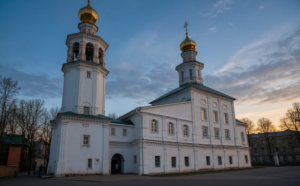
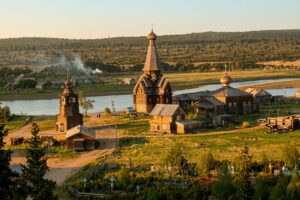
There are places where time seems to forget to move forward. Ferapontov Monastery is one of these places. Lost among the Vologda hills, on the isthmus between Ferapontovsky and Spassky lakes, it has stood for more than six centuries — intimate, quiet, almost homely. No oppressive grandeur, no ceremonial gloss. Only white walls reflected in the water and the sky above the domes — this is how the monk Ferapont saw them, who came here in 1398 from distant countries.
Ferapont did not choose this place by chance. The northern wilderness, forest silence, expanse of lakes — everything was conducive to prayer and solitude. From a small cell a monastery grew, which was destined to become one of the main spiritual centers of Belozerye. A few decades later, Martinian, a student of another great ascetic, Kirill Belozersky, came here and headed the monastery, breathing new life into it.
The main treasure of the Ferapontov Monastery is hidden behind the walls of the Cathedral of the Nativity of the Virgin. In 1502, the icon painter Dionysius, the most significant artist of his era, together with his sons, painted the cathedral in an incredibly short period of time: from August to September.
Six hundred square meters of painting created in just over thirty days.
The date of the beginning and end of the work is indicated in the chronicle on the slope of the northern door, which makes the painting of Dionysius the only reliably confirmed work of his in the field of monumental painting.
Entering under the arches of the cathedral, you find yourself in a special world. The colors are soft, slightly muted, like the morning northern light, they do not shout, but speak in a low voice. Scenes
Akathist to the Mother of God, Ecumenical Councils, and the Last Judgment form a single theological story unfolding on the walls, vaults and window slopes. It’s amazing: for five centuries this painting has not been restored — we have before us the original author’s layer, untouched by the restorers.
The monastery ensemble itself developed gradually — from the first stone cathedral of the late 15th century to the churches and bell tower built in the 17th century. The buildings are verified and coordinated with each other as if they were erected according to a single plan, although they are separated by entire eras. The architecture here does not argue with the landscape — it grows out of it, like an old tree grows out of the bank.
A separate page in the history of the monastery is connected with Patriarch Nikon: the disgraced reformer spent many years of exile here. Fate decreed that one of the most powerful church figures in Russia turned out to be a recluse in this quiet monastery, and the northern beauty became for him not a reward, but a test.
Today, within the walls of the Ferapontov Monastery there is a Museum of Frescoes of Dionysius. In 2000, UNESCO included the ensemble on the list of World Heritage Sites — a rare case when international recognition is not at odds with what you feel standing at these walls. Since 2018, the monastery has been operating again: prayer and history coexist here again, not interfering, but complementing each other. As planned six centuries ago.
Charity FoundationHoly Land
Temples and Monasteries of Russia