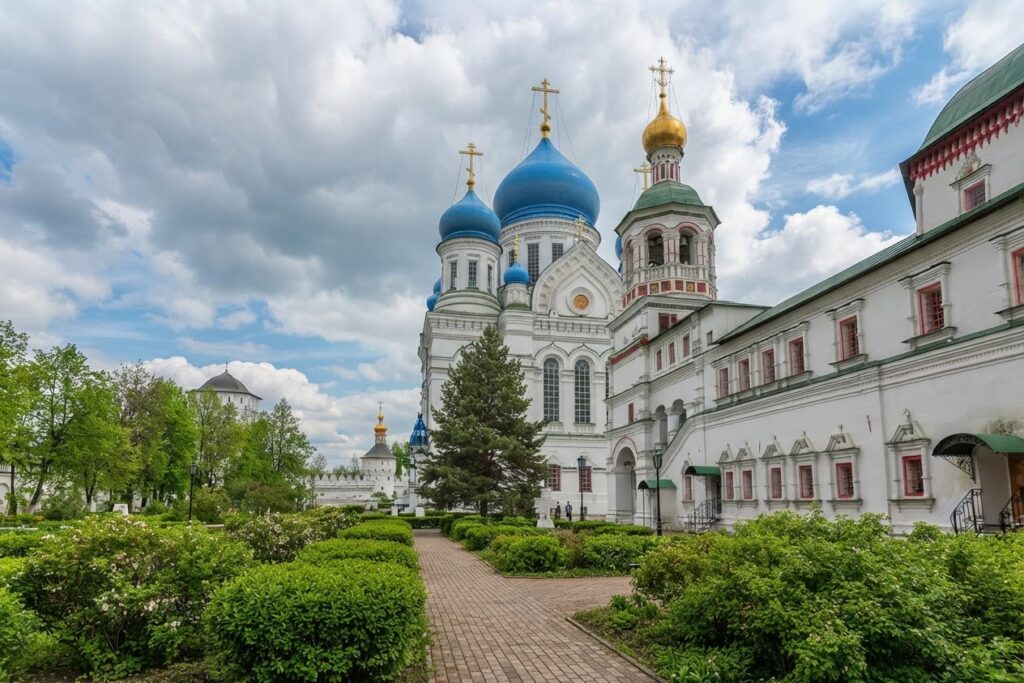
If you drive along Shosseynaya Street in the Pechatniki district of Moscow, you may not notice the monastery behind a high fence and trees. But as soon as you enter the gate, a picture of unexpected beauty opens up: an ancient cathedral with tiled cherubs on the bell tower, a five-domed giant temple of the Russian-Byzantine style, a gate church, bishops’ chambers, seminary buildings. All these are the remains of the monastery, which survived the patriarch, the revolution, the factory floors and was reborn under the name of the Patriarchal Compound.
The river has interrupted its flow
The name “Pererva” is explained by geography. The Moscow River in this place once abruptly changed its course, turning away from the monastery hill towards the village of Kolomenskoye. The old channel ceased to be flowing — the flow in it seemed to be “interrupted”. That’s why Pererva.
It is not known exactly when the monastery appeared here. Tradition connects the foundation with the Battle of Kulikovo and calls the monastery an ancient outpost on the southern approaches to Moscow. The documents are silent until the scribe book of 1623, where the wooden church of St. Nicholas the Wonderworker, the abbot and two elders are mentioned. Previously, the monastery was called “St. Nicholas the Old” — apparently because even for the 17th century it was old.
During the Time of Troubles, the monastery probably suffered from the raid of the Crimean Khan Devlet-Girey in 1571 or from the Polish devastation — in any case, by 1623 it was extremely poor: seven Bobyl courtyards, half a thousand hectares of arable land and a tiny patch of forest. Tsar Mikhail Fedorovich helped return the meadow to the monastery, which had belonged to it “since ancient times.”
Alexey Mikhailovich and stone construction
The monastery truly rose under Tsar Alexei Mikhailovich. From 1649 to 1674, three stone churches were erected: the Assumption, St. Nicholas the Wonderworker and St. Sergius of Radonezh. The monastery acquired a stone fence, a front garden, an orchard under the mountain and a beekeeper.
In 1666, the Iveron Chapel at the Resurrection Gate of Kitay-Gorod was added to the monastery — the same one that stood on Red Square. The chapel generated income, and the money went to maintain the monastery and theological school. Later, chapels in the Sukharev Tower, at the Kaluga and Serpukhov Gates were added to the Pererva possessions.
Patriarch Adrian and his cathedral
The main turn in the history of the monastery occurred at the end of the 17th century, when Patriarch Adrian — the last patriarch of pre-Petrine Rus’ — made Pererva his summer residence. He was already old and sick, was burdened by the innovations of the young Tsar Peter and increasingly left Moscow here.
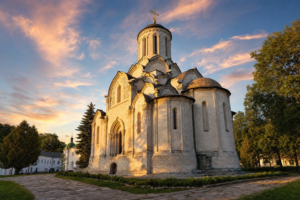
Adrian decided to rebuild the monastery churches. Three small stone churches — Assumption, St. Nicholas and Sergievskaya — were dismantled and a single two-story cathedral was built in their place. Construction took four years, from 1696 to 1700. On the top floor there is the Church of St. Nicholas the Wonderworker, on the bottom floor there is the warm refectory Church of St. Sergius of Radonezh, and on the third tier of the bell tower, on the north-eastern side, there is a small Assumption Church. The composition was unusual: the bell tower was placed not in the west, as is customary, but in the east — because each of the former churches stood in its own historical place, and the patriarch wanted to preserve their thrones.
The bell tier of the Assumption Church was decorated with colored tiles depicting cherubs. The bell tower turned out to be five-tiered — higher than many Moscow parish churches. A wooden gallery led to the cathedral from the patriarch’s chambers: the sick Adrian could enter the temple directly from his cells. In one of the corners of the upper church, according to legend, a chapel was built, from where the patriarch listened to the divine service through a window, then covered with bricks.
On September 29, 1700, Adrian himself consecrated the cathedral. A month later he was gone. He was buried on the territory of the monastery.
Metropolitan Plato and Seminary
The 18th century brought new prosperity to the monastery — now under Metropolitan Plato (Levshin), one of the most prominent church figures of Catherine’s era. In 1775, Plato opened a theological seminary in the monastery — it was called Plato’s. The students ate in the fraternal refectory of the lower Sergius Church, and the classes were housed in specially built buildings.
The list of Plato’s works on the improvement of the monastery was engraved on a stone slab embedded in the wall at the eastern doors of St. Nicholas Cathedral — thirty-eight items. Among them: a cast-iron floor in the upper church, renovation of wall paintings, gilded domes, a fighting clock with quarters on the bell tower, a stone garden fence, a bishop’s house, a leveled and turf-lined mountain. Bees grazed in the garden under the mountain, fruit trees grew on the slope, and fish splashed in the pond.
In the 1750s–1760s, the Assumption Church in the bell tower was painted in the Baroque style. The stucco moldings — cornices, cartouches, cherubs — were covered with gilding. There is an assumption that Bartolomeo Rastrelli himself did the stucco work, although there is no direct evidence of this. Catherine II, traveling to Crimea, stopped at the monastery.
1812 and the French
In 1812, the French entered the monastery. They removed the crowns from the icons, dismantled part of the chandelier, and dined and slept in the lower Sergius Church. But the main valuables were taken out or hidden. After the French left, the temple was restored: in 1813, the upper St. Nicholas Church was re-consecrated, and in 1811, the old iconostasis of the late 17th century was replaced with a new, six-tiered one — while preserving the old royal doors.
In 1834–1836, the residential and utility buildings were rebuilt according to the design of the architect Mikhail Bove — the same one who restored Moscow after the fire of 1812.
Iveron Cathedral: a gigantic temple
By the beginning of the 20th century, the monastery became cramped for the ever-increasing number of pilgrims. In 1904, a new cathedral was founded in the name of the Iveron Icon of the Mother of God — a huge, five-domed, cross-domed cathedral, accommodating up to three thousand people. Architect Pyotr Vinogradov designed it in the Russian-Byzantine style: massive volumes, wide domes, meticulous brickwork with decorative machicolations and niches. The dedication took place on September 8, 1908; it was conducted by Metropolitan Vladimir, the future martyr.
Next to the new cathedral, a new stone wall was erected on the east and north, crowned with battlements, with high decorative gables above the gate. The old Holy Gate with a Gothic tower was dismantled — it interfered with construction.
A religious school and a school for the deaf and dumb, opened in 1906, operated at the monastery. It had its own orchard, beekeeper, pond, hospital with a pharmacy and a paramedic.
Sunset
After 1917, the monastery died slowly and painfully. In 1918, the churches were handed over to the community of believers — legally the monastery ceased to exist. In 1924, the Tolga Gate Church was closed and given over to a club and a canteen for an orphanage at the Kursk Railway. By 1928, there were three inhabitants left in the monastery — two archimandrites and a regent-hieromonk. The brothers were no longer there. Officially, the monastery was closed, and in 1931 it was deprotected as an architectural monument.
The Cathedral of St. Nicholas the Wonderworker lasted longer — services were held there until 1941. Before Easter that year, believers came to bless the Easter cakes, but found the temple sealed; the rector, Archpriest Alexander, was arrested. After the war, a galvanizing shop was set up in the cathedral: the masonry of the walls and vaults was damaged, the paintings were painted over, the floors and stairs were dismantled, and the clock mechanism of the bell tower was destroyed. Iversky Cathedral was turned into a warehouse and workshop of the Stankokonstruktsiya plant; chapters, crosses, iconostasis — everything was lost, interfloor ceilings were stuck inside.
The territory was filled with factories — toys and machine-tool structures. Housing was arranged in the cells.
Return
On January 8, 1991, St. Nicholas Cathedral was transferred to the community of the Russian Orthodox Church. Several believers, led by Archpriest Vladimir Chuvikin, came to the ruined church. On March 29, 1991, on the Friday before Lazarus Saturday, he consecrated the temple with a small rite. The first liturgy in the Assumption Church of the Bell Tower took place on April 1, 1993.
By 1994, the plant had completely vacated the territory. On October 12, 1993, the entire monastery was transferred to the Church for indefinite free use. In 1995, the Patriarchal Metochion was established. In 1996, the Perervinsky Theological School was revived. The Tolga Gate Church was opened in 1992, restored and consecrated with a great rite in 2016.
The restoration of St. Nicholas Cathedral lasted from 1978 to 2001. During the work, they discovered white stone carved gravestones from the late 16th to mid-17th centuries, which were used in the construction of the cathedral as building material. In 1996, near the walls of the cathedral, the remains found on the territory were buried in a mass grave — the inhabitants and benefactors of the monastery of previous centuries.
In 2014, between the vegetable garden and the bank of the Moscow River, a small wooden church was recreated and consecrated in the name of the holy righteous Nicodemus — in memory of the house church built in the patriarchal cells in 1870.
What can be seen today
St. Nicholas Cathedral (1696–1700).A two-story temple built by Patriarch Adrian. The top floor is the summer church of St. Nicholas the Wonderworker, the bottom floor is the warm refectory of St. Sergius of Radonezh. The bell tower is on the eastern side, in the third tier is the Assumption Church with Baroque stucco molding and tiled cherubs. A slab with a list of the works of Metropolitan Plato is at the eastern door.
Iveron Cathedral (1904–1908).The five-domed giant temple of the architect Pyotr Vinogradov, accommodating up to three thousand people. The southern aisle is in the name of Equal-to-the-Apostles Prince Vladimir, the northern one is the Nativity of John the Baptist.
Gate Church of the Tolga Icon of the Mother of God (1733–1735). Built in the Baroque style over the Water Gate of the monastery fence.
The Bishop’s House (1805–1808) and the Patriarchal Chambers. Residential and utility buildings of the 18th–19th centuries, including buildings by the architect M. I. Bove.
The Perervinsky seminary, a Sunday school, the Orthodox theater “Lampada”, and the youth movement “Derzhava” operate at the metochion. Divine services are held regularly. There is no monastic brethren on the territory — the monastery has the status of the Patriarchal metochion, and in the documents it is still listed as a “former monastery.”
The monastery is located at the address: Moscow, Shosseynaya street, building 82. Open daily from 07:30 to 20:00. The nearest metro station is Pechatniki.
Why you should come
Nikolo-Perervinsky Monastery is one of those places where the history of the Russian church is visible as if at a cross-section. 17th century — Patriarch Adrian and his cathedral with cherubs. XVIII — Metropolitan Platon, seminary, baroque stucco. XIX — Beauvais and the bishops’ chambers. XX — factory floors in the altar and rebirth from the ashes. All this is on a small patch near the bend of the Moscow River, far from tourist routes, in an ordinary residential area. Once you enter the gate, the residential area disappears.
Charitable FoundationHoly Land
Temples and Monasteries of Russia