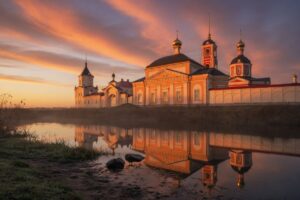
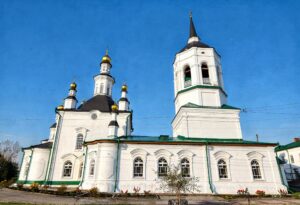
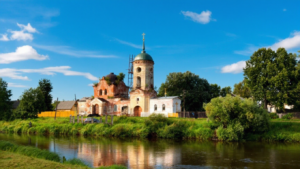
The foundation of the monastery is associated with a historical event and a happy salvation. In 1356, Bishop Alexy was blessed by the Patriarch to serve as Metropolitan of Moscow. In honor of this event, he was presented with the icon of the Savior Not Made by Hands. Returning from Constantinople,
The ship was caught in a storm and there was no hope of escape. However, the metropolitan prayed before the icon and vowed that if all survived, he would build a monastery specifically for this icon.
The sea calmed down, the ship safely landed on shore. The metropolitan kept his word and, on his return to Moscow, began the construction of the monastery.
The place was chosen on the banks of Yauza, and the stream that flowed into it was called the Golden Horn, in memory of the storm that played out in the Golden Horn Bay. The place was brisk, at the crossroads that led to Vladimir, Ryazan and the distant, dangerous Golden Horde. Therefore, the monastery is well fortified.
It was possible to hide from the enemy.
After a glorious victory on the Kulikovo field, it was here that the fallen Russian heroes were buried.
The first abbot of the Savior Monastery was Abbot Andronik. Before that he was a monk in the Trinity-Sergius Lavra, he was considered a student of Sergius of Radonezh. Later his name was added to the name of the monastery.
The first Spasska Cathedral of the monastery was wooden. It burned down in 1368. In its place, a stone was built, some fragments were preserved from it. The painting of this building was entrusted to the monk of the monastery Andrei Rublev. Fragments of the frescoes have survived. Oral belief states that
Andrei Rublev is buried on the territory of the monastery, but the location of the grave is unknown.
In the first half of the 15th century, the temple was rebuilt again and in this form it still pleases the eye.
The monastery complex was constantly being built. A two-storey refectory, a new main gate, was erected. First wooden, and later stone. Above them was built the Church of the Nativity of the Virgin.
The famous Spasska Monastery was its library. From morning until late at night the monks worked, copying the Gospels and the lives of the saints. The manuscript library contained a huge number of works of which little remained. Most of them died in a fire in 1748.
In the 16th century, the monastery became a place of exile for the unwanted. Here was sent Bishop Serapion of Novgorod and Abbot Artemius, who were convicted of heresy. Protopop was held here.
Avvakum.
In the 17th century, many new buildings appeared in the monastery. Mostly thanks to the wife of Tsar Peter — Eudocia. The queen did not spare money for the monastery. At her command began to build the Church of Archangel Michael. Above the refectory appeared the church of St. Alexis. It was equipped.
The family tomb of the Lopukhins — relatives of the queen.
In the 18th century, the monastery buildings were repeatedly rebuilt. Wooden walls were replaced by stone ones, a bell tower was erected, a papert was added to the cathedral.
In 1812, the French looted the monastery and set it on fire. What survived from the fire of the 18th century burned down in the 19th. The most valuable archive, the library, is missing. The recovery took a long time.
In the 19th century, a spiritual school was opened at the monastery.
After the revolution of 1917, the monastery was closed, and its riches: icons, embroidered veils, candlesticks and censers disappeared without a trace. A small part of these objects was returned when the museum of Andrei Rublev was arranged on the territory of the monastery.
In the buildings of the monastery opened a colony for street children, and later — a hostel.
After the Great Patriotic War, interest in history increased and the monastery began to revive as an object of historical heritage. The museum of Andrei Rublev was opened, the restoration of the cathedral began.
In 1989, divine services were resumed in the Savior Church.
Archaeological excavations are carried out on the territory. During the work, an old church papert and 2 graves were discovered. There is controversy over burials. Some scientists claim that these are the graves of Andrei Rublev and Daniel Cherny, and others – the abbot Andronikos and the Monk Sava.
Although the frescoes on the walls are almost not preserved, the decoration of the cathedral amazes with its splendor. And in the Rublev Museum you can see the oldest Russian icons.
Charitable Foundation Holy Land
Russian Temples and Monasteries