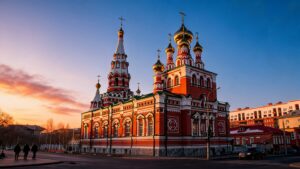
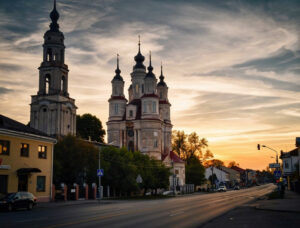
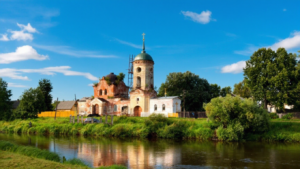
On the Astrakhan Kiselevsky hill, where the dry steppe wind interferes with the dust with the Volga moisture, there is a church whose biography is similar to life — with a miraculous finding of a house, a military wound and a revival from the ruins. Her story began not with a magnificent decree, but with the quiet request of the inhabitants of the Rootless Sloboda.
In the middle of the XVIII century, at the crowded Church of the Cross, an orphaned wooden church in the name of John Chrysostom was not needed by anyone. The villagers saw their future shrine in an abandoned log cabin. In 1763 they went to Bishop Methodius and begged permission to transfer her to the hill. Disassembled on a log, with prayers and care, the church was rolled over to a new place, put in the center of the settlement and established a parish. The children immediately began to cut small crosses from the chips — so a simple wooden structure became the heart of the settlement.
However, the tree is rapidly decaying in the local climate. By the early 1820s, ministers sounded the alarm and begged for a collection book for stone construction in the Spiritual Consistory. The money was collected by the whole world, but the main donor was the merchant Ivan Petrovich Sharygin. Three years — from 1823 to 1826 — a new temple grew over the hill. It was built in a single ensemble: a high two-tier bell tower, a spacious refectory and the main volume merged into a slender composition. In October 1826, Archbishop Paul (Subotovsky) sprinkled the walls, and a thick bell ringing floated over the Volga. Nothing seemed to disturb that peace.
But the twentieth century hit the church with a gunshot. On March 10, 1919, the Astrakhan workers revolted against Soviet power, and the destroyer Moskovitian approached to suppress the uprising. One of the shells with a howl crashed directly into the bell tower — it formed like a house of cards, leaving behind a cloud of brick dust. The silence was ominous. However, the believers did not resign themselves: by 1923 they had restored the belfry exactly as it was before.
The trouble came again in 1938. The temple was closed, and the bell tower was ruthlessly broken — now to the ground. In 1944, the church opened its doors to worshippers. At the same time, Archbishop Philip (Stavitsky) renamed the right chapel from Tolga in honor of the icon of the Mother of God “All those who mourn Joy” – as if reminding the suffering people that they are not alone in their sorrow.
The appearance of the temple is a real architectural diary of reconstructions. The plan of the building eventually acquired the outline of a cross, and the facades were dressed in the decor of late classicism. In the second half of the XIX century, they were rebuilt again, and then amazing stucco bas-reliefs appeared. They seemed to freeze the painting of Nikolai Ge: the severe inevitability of suffering, the power of asceticism, quiet sorrow. At the entrance there is a figure of Christ, and on the western facade of the belfry, inclined angels froze, whose faces seem to keep the light of that very gun salvo.
Today’s bell tower is an almost mystical return of the lost. In August 2001, the laying of the first stone was consecrated, and in 2002, a two-tiered vertical once again ascended over the hill. It was built in a strict classical key, repeating the pre-revolutionary appearance to the smallest detail. And now the temple looks the same as before the catastrophe of 1919 — harmonious, whole, alive.
Looking at this church, you involuntarily feel that through the thickness of a brick comes the main thing — the ineradicable ability of faith to be reborn from dust and roar, preserving in the bas-reliefs a quiet memory of the experience.
Charity FundHoly Land.
Russian Temples and Monasteries