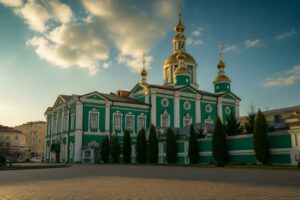
The fire of faith has always burned in the hearts of the Russian people. Where faith is, there are temples. In the swampy, sparsely populated part of Perm, construction of housing for workers began. Housing appeared, and to the nearest temple — 3 versts. The merchant Babalov, who built houses for workers, allocated a plot for a temple. Money was collected by the whole world. At first, donations were generous. The Ural merchants did not skimp on gifts. They ordered a sketch, made drawings and in 1904 laid the walls of the future church. But then the Russo-Japanese war began and the construction of the church lasted for several years. Only in 1910 the temple was consecrated in honor of the Ascension of the Lord. One of the chapels was dedicated to St. Theodosius of Chernigov, so the old-timers call this church Theodosevskaya.
The building is built in the form of a ship, it has 4 thrones, 2 upper and 2 lower. The walls are made of red brick, in the temple part the vault is semicircular, unusual. The bell tower is traditional, tented.
The location was well chosen. The city grew and now it was not a swampy desert, but practically the center. There were many parishioners, their number increased when a particle of the relics of Theodosius of Chernigov was delivered to the temple.

After the revolution for the right to conduct services, a struggle broke out between the adherents of Patriarch Tikhon and the “renovators”. The first held services in the lower temple, and the second in the upper.
For a short time, the Ascension temple became a cathedral. There found shelter monks of their closed monasteries, priests from the abolished parishes. A Sunday school was opened in the church. In the 30s, the church was closed. The room was given to the hostel of the bakery.
The building has undergone many alterations, completions. Gradually it came into an emergency state. In the 80s they wanted to repair it and organize an organ hall there. In the last mine it turned out that the bearing ceilings will not withstand the equipment. The building was almost demolished, but then the Soviet Union collapsed and instead of demolition it was returned to believers.
Restoration work began immediately, which lasted 20 years. Completely updated the facade, put new baths, repaired the bell tower.
The interior walls were painted. A new iconostasis was made, but the icons for it were collected by ancient, Uralic ones. 90 years after the foundation of the temple, services were resumed.
In 2004, the centenary of the temple was celebrated. For this event it was decorated with illumination, so now you can admire the church architecture in the dark.
Charitable Foundation Holy Land
Russian Temples and Monasteries