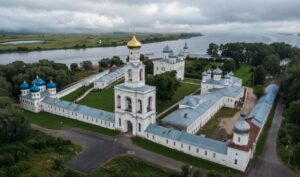
The stone chronicle on Solikamsk land keeps an amazing plot: a monastery that was destined to be born three times. Its walls absorbed the prayers of peasants and breeders, the groans of prisoners of transit prison and the silence of desolation. Today, crossing the threshold of the Holy Trinity Monastery, it is as if you are leafing through the pages of living history – rough, tragic, but permeated with light.
At the end of the XVI century, about 1589-1591, Posad people and county peasants erected a wooden Ascension Church. The names of the first guardians were preserved — Vasily Anofriev and Prokopi Moiseev. The modest undertaking grew into a strong monastery: by the beginning of the XVII century the hegumen’s word had already sounded here, and at the turn of the century the wooden Vozdvizhenskaya church gave way to a stone one. The walls are dressed in bricks reliably and for a long time.
However, fate was not condescending. In 1764, the monastery was considered too poor and taken out of state. The deserted temples waited for their fate for eleven years, until the life of the monks of the Pyskorsky Transfiguration Monastery was breathed here. And after their departure, already in 1795, the brothers of the Trinity Istobensky Monastery arrived from the distant Vyatka Territory. It was then that the Ascension temple acquired a new name — Trinity, with a warm Annunciation chapel. The gate church, formerly consecrated in the name of Michael Malein, became Sorrowful — in honor of the icon of the Virgin «Joy of All Who Sorrow.» In her upper chapel was placed the throne of the Ascension of Christ.
The architectural ensemble developed gradually, absorbing the generosity of benefactors. In the 1730s, “through the efforts of the factory owner Turchaninov,” a hospital and an elegant gate bell tower grew. But the special breath of the monastery is given not only by walls — its spirit is woven from human destinies. Here served the Hieromartyr Theophan, Bishop of Solikamsk. In 1918, he was subjected to a terrible execution: immersed in an ice hole until his body was covered with a crust of ice. Today, the monastery has a Feofanovsky chapel — in memory of one whose faith did not drown.
The XX century experienced the monastery on the break. In 1928, the monastery was taken away, giving the potash trust. Since 1938, the transfer prison of the NKVD has been located here — the grinding of locks and the steps of the convoy silenced the echoes of former chants of a long half century. It seemed like a point. In October 1998, the buildings were returned to the Church. And already on the Epiphany of 1999 in the Annunciation chapel the first candle was heated. This moment was a harbinger of a new spring for the prayer walls.
Now the monastery comes alive again: buildings are restored, the territory is landscaped. Here, at the white-stone vaults where once prayed a bishop who accepted a martyr’s death, the same eternal hope sounds as it did centuries ago. And it seems as if the Solovetsky wind that walked among the prison people gave way forever to peace.
Charity FundHoly Land.
Russian Temples and Monasteries