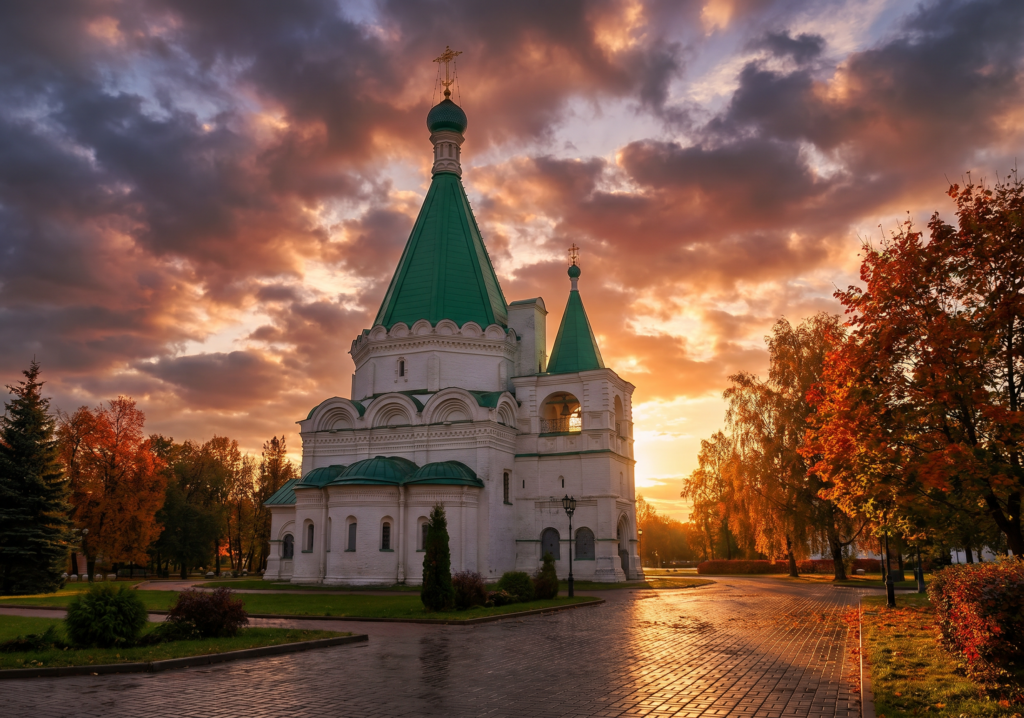
If you close your eyes on the Clock Mountain of the Nizhny Novgorod Kremlin, you can hear time flowing through the stone. Here, on the windiest hill above the Volga, history has not frozen in museum windows — it breathes in full. The white silhouette of the cathedral, aimed at the sky with a tent, meets everyone who sets foot on the ancient land. But few people know: this temple is the same age as the city itself. He was born in 1221 at the behest of Prince Yuri Vsevolodovich, who, according to legend, personally indicated a place for a wooden church in the name of the patron of the Russian army, Archangel Michael.
Six years later, the tree was replaced by white stone. Those masters who decorated the temples of Vladimir and Suzdal left their mark here — archaeologists of the mid-twentieth century found their «autographs» in the form of fragments of carved decoration hidden in the depths of the earth. It seemed that nothing would break this stronghold, but the Horde invasion made its severe adjustments. Only a century later, when Nizhny Novgorod gained the status of the capital of an independent principality, the cathedral rose from the ashes to become not just a house church, but also a tomb for the Grand Dukes.
The current appearance of the cathedral is a story of heroism and gratitude. By the beginning of the XVII century, the building was dilapidated, but it was at its walls that Kuzma Minin called Nizhny Novgorod residents to collect militia. When the Troubles ended, the new royal dynasty of the Romanovs could not leave such a symbol unnoticed. In 1628, stone craftsman Lavrentiy Vosoulin and his stepson Antipas arrived here. They had to build a temple-monument, and they created the miracle that we see today.
The building is unique for the first half of the XVII century: it is a single ensemble, where the church and the bell tower are connected into a single organism. If you look closely, you can see how inside the western and southern walls a stone staircase leads up to the bell ringer. In those days, he not only beat the rhythm, but also through the arched opening saw everything that happens in the temple, checking the ringing with the course of the service.
In terms of the cathedral resembles a cross. The massive four is crowned with an eight-american, and an octagonal tent almost 40 meters high rises above it. Architects deliberately narrowed the windows to slit-shaped openings to enhance the sense of aspiration upwards. Initially, green tiles on the chapters, made by Balakhnin craftsmen, retained its “scaly” pattern, reminiscent of antiquity.
There’s a special acoustics inside. The secret lies in the clay jars-voicers, embedded in the thickness of the walls. They create the sound that catches your breath. The frescoes on the walls are a chronicle painted in colors. Among the plots you can see the vision of Prince Yuri Vsevolodovich, where the coming great city appears before him in the haze of time, and the main cathedral is recognized unmistakably.
The temple experienced a lot: the destruction of the chapel of John the Theologian in the XX century, the closure in the 20s, for many decades as a museum branch. It was then, after the destruction of the Transfiguration Cathedral, the ashes of Kuzma Minin were transferred here. Now under a stone slab in the northwest corner rests the ashes of the same citizen whose voice once rang out at these walls. Only in 2000, at Holy Week, the life of worship returned here.
Near the cathedral, Prince Yuri Vsevolodovich froze in bronze with his spiritual mentor, Bishop Simon of Suzdal. Their figures symbolize the continuity of worldly power and spiritual faith. Standing here on the edge of the Kremlin hill, you begin to realize that this temple is not just an architectural monument. This is the main guardian of Nizhny Novgorod history, which, despite centuries and storms, still looks to the future.
Charity FundHoly Land.
Russian Temples and Monasteries