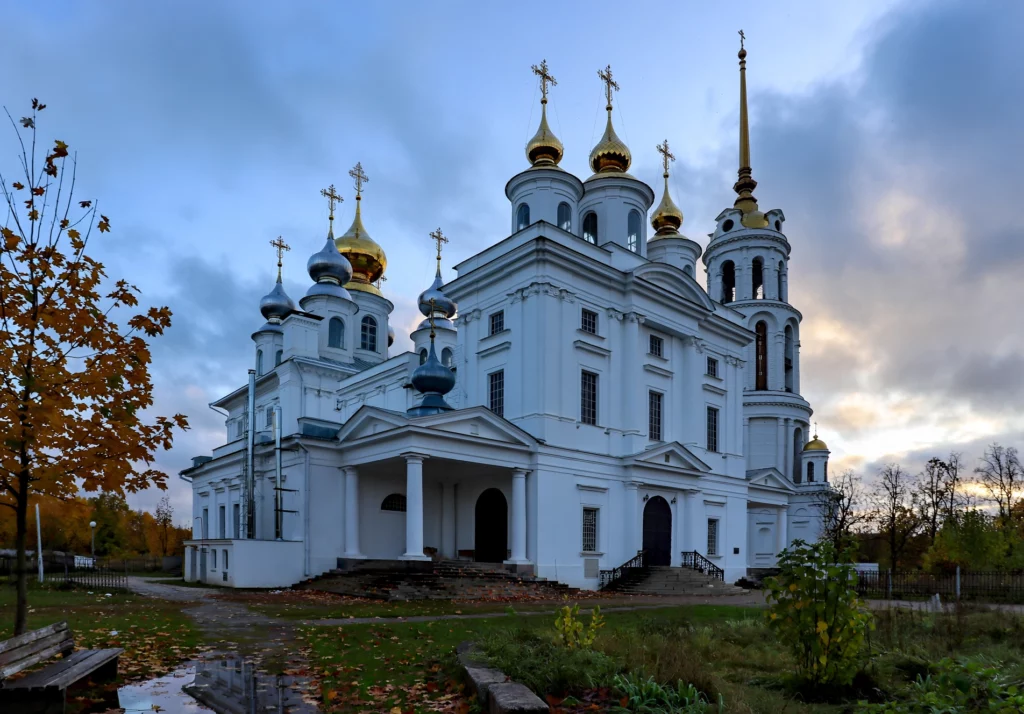
Imagine a city where the main architectural dominant is visible for several kilometers. In Shuya, it’s not just a bell tower — it’s a vertical that defies time. Its 106-meter spire goes into the sky so fast that it seems as if it connects the bustle of the earth with heavenly eternity. It is the tallest freestanding belfry in Europe, but its fame is not only based on height records. Too many human destinies, miracles and tragedies are forever woven into her brickwork.
The ensemble of the Resurrection Cathedral is three epochs frozen in stone. The main temple, which appeared at the end of the XVIII century, keeps the memory of the old Russian classicism. Nearby is a more modest St. Nicholas Church, which is older than the main cathedral by half a century. But the main character here is definitely a bell tower.
Her story began with an adventure. In 1810, the Italian architect Gaudencio Maricelli conceived a grandiose structure, but after erecting three tiers, the architect made a fatal mistake: the structure collapsed. Fortunately, there were no casualties, but the ambitious project had to be handed over to the student of the famous Kazakov — Evgraf Petrov. It was he who gave the bell tower its recognizable, slightly squat silhouette, which, contrary to the laws of physics, allowed the building to rush up almost 40 meters above the original plan.
However, the main mysteries of this bell tower are related to metal. At the end of the XIX century, a giant bell weighing 20 tons appeared on the bell tower. They cast it in honor of the miraculous rescue of the royal family in the crash of a train near Kharkov. But the way to the destination was almost his last: transporting the “giant” across the river Tesa, the carts fell under the ice. The deep water became his home for a few weeks. Local daredevils, diving into the icy March water, were able to start ropes and literally pull the shrine out of the river captivity.
And decades later, already in Soviet times, the bell suffered a terrible fate. He was thrown from a height, and he went one and a half meters into the frozen ground, then to be broken by a hammer. As they later tried to break the faith of the people.
In 1922, a drama played out at the walls of this temple, which became the trigger for mass persecution throughout the country. Formally, the withdrawal of valuables was explained by the help of the hungry, but in Shuya people stood up as a wall, not letting a commission into the cathedral. They defended the miraculous Shuyskaya-Smolensk Icon, which two centuries earlier had already saved the city from the plague. According to legend, this image, painted by the icon painter Gerasim Ikonnikov at the height of the epidemic, miraculously changed the picture on the board, and when introduced into the temple radiated unearthly light. More retreated.
In March 1922, the defenders of the cathedral were shot with machine guns from this very bell tower. The nabat, which sounded then, became a funeral bell for hundreds of clergy throughout Russia. In memory of these events, at the foot of the belfry today stands a monument to the new martyrs, and the history of the “Shui case” forever remained in the textbooks as the moment when the political massacre was clothed in a religious shell.
Today, the bell tower regained its voice. Her spire is not just a decoration. In 1868, it was rebuilt according to the project of the engineer Zhuravsky, taking as a basis the principles later applied in the creation of the Eiffel Tower. The steel structure, which replaced the old wooden spire, was so reliable that it survived both revolutions and wars.
Rising to the tiers of the belfry, where today hang two rescued ancient bells, it is difficult to get rid of the feeling that time flows differently here. Below is the bustle of a provincial city, and here, at a bird’s eye view, you feel the very connection of times. From the icon that saved the city from the pestilence, to the steel frame that absorbed the engineering thought of two eras; from the execution of the defenders of the faith to the festive procession, which today annually gathers thousands of pilgrims.
The Sunday Cathedral in Shuya is not just an architectural monument. It is a living organism that remembers how it was built, how it was lost, and how, after decades of desolation, it returned to it. And looking at its majestic silhouette, you understand: as long as such bell towers stand, the Russian land will not really die.
Charity FundHoly Land.
Russian Temples and Monasteries