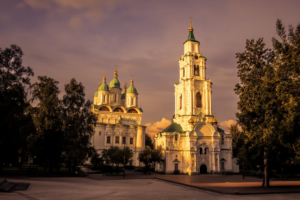
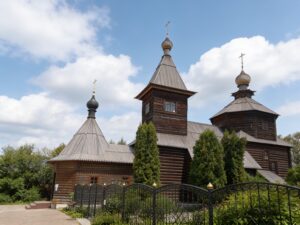
In the Russian land, churches were erected in honor of St. Sophia, but until then no monastery with such dedication existed here. Rybinsk was destined to be an exception. The monastery, which appeared on the banks of the Korovka River in 1860, was the first and only Sophia monastery in the whole country. Like a spiritual outpost, it marked the special mission of the Volga city, becoming its silent banner.
The history of this place is woven of amazing coincidences and fates. To begin with, the very place at the Rattle Creek was destined to become a saint. The local merchant Andrei Miklyutin, the future benefactor and builder of the city’s Transfiguration Cathedral, learned about it as a child – as something hidden, indicated to him from above. Later, the plan will become flesh thanks to two ascetics: Elder Adrian of Yuga, who gathered the first community, and Priest Peter Tomanitsky, a visionary elder who blessed this particular piece of land by the river.
Peter Tomanitsky is called the spiritual father of the monastery. He did not live to its lush heyday, but managed to lay the stone in the foundation. In 1866 he was buried in the porch of the Sophia church under construction. Next to him, in fact, found eternal peace and the very idea of the monastery. The funds for the construction were allocated by the same merchant Miklyutin, but the first abbess, the widow from Bezhetsk, he personally appointed the abbess — this right was granted to him by the Holy Synod. Lyubov Alekseevna took tonsure with the name Sophia and for thirty years led the monastery along the path that was destined for her.
By the beginning of the XX century, life was boiling here. About two hundred women, a school for orphaned girls, a cathedral church in honor of St. Sophia and a warm church in honor of the icon “All the Sorrowful Joy” – the ensemble looked complete and majestic. Over the consecration of churches worked Archpriest Rodion Putyatin, whose name in Rybinsk was a sign of high spiritual authority.
But this story, unfortunately, has a second, tragic chapter. In 1923, the monastery was closed. A decade later, the NKVD prison was located here. It so happened that the place of prayer and silence turned into a “Sofia” – an insulator that everyone in the city knows. Cells became chambers and cathedrals became ruins. Until recently, there was a strict regime colony here, and only one building miraculously escaped this fate.
Today, passing along Gremyachevskaya Street, it is hard to believe that prayer is again warmed behind these walls. In 2009, struggling through the monstrous rubble of the Soviet era, local residents and priests began clearing the ruins. In the only surviving cell building, a house church was consecrated in honor of the icon “Indestructible Wall”. The name is symbolic: faith here really proved indestructible.
In 2015, the Holy Synod officially revived the Sofia Women’s Monastery. Abbess Seraphim received a staff and a cross to guide the rebirth. However, the paradox of modernity remains: most of the historical territory is still occupied by a detention center. The all-morrowful church, which was not touched only because it crumbled itself, stands in ruins. The monastery and the prison are adjacent to the same fence — a symbol of broken time, which is trying to glue together.
And yet this place does not leave indifferent. Here lie the famous ascetics: nun Sergius, the founder of the Leushinsky monastery, and the last of the elders, schimonachina Agnes, whose grave in the city cemetery still keeps traces of folk love. This is a reminder that no historical storm can undo the main thing. Rybinsky Sophia Monastery once became the first in Russia. Now it may be regaining its status, not only in architecture but also in destiny.
Charity FundHoly Land.
Russian Temples and Monasteries