In 1558, the Astrakhan Khanate was defeated, and its territory became part of Russia. On the site of an ancient, but decayed village, a new city was laid — Astrakhan. A city that became a military outpost and trade gateway to Asia. Settlers poured into the new city. For them, Abbot Kirill built a wooden church in the name of the Vladimir Icon of the Mother of God. The icon itself was given by Ivan the Terrible.
The city grew rapidly, the number of parishioners too, and a small wooden church could not accommodate everyone. It was decided to build a large stone cathedral. The construction was completed in 1602. We have dedicated the time of the Most Holy Mother of God. The temple was built in a hurry, so it quickly began to decay and it became dangerous to be in it.

The metropolitan addressed the tsars (at that time two tsars sat on the throne at once: Ivan and Peter Alekseevich), but to no avail. The local merchant helped, and the stimulus was the plague. The epidemic claimed the lives of dozens, so the money for the temple did not spare, hoping that the Lord
He will, and the disease will go away. Therefore, the temple turned out to be luxurious.
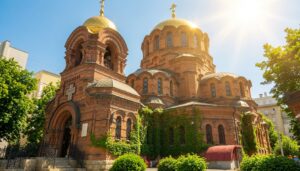
On the construction worked 30 masons led by serf architect Dorofei Myakishev. The construction was carried out for 12 years and was constantly interrupted by the Strelets riot, then by a strong fire that destroyed the top of the building. I had to remake, rebuild and start over several times. Only in 1710 the cathedral became an active temple. A tomb was made in the lower temple. The bodies of metropolitans and bishops were transferred here. There are also buried 2 Georgian kings: Vakhtang and Teimuraz.

No time or effort was spared for the decoration of the temple. Carving on white stone, ornamentation with shaped brick, framing with columns attracted the eye, pleased the heart. The arches were painted with biblical stories. The iconostasis was famous for the silver royal gate,
Made in St. Petersburg to order.
The Bolsheviks came and destroyed the iconostasis. Just burned it on Saturday. The utensils were pulled and the temple stood idle for some time, in 1922, according to the prayers of parishioners and the official requests of the bishop, it was returned to the faithful. But in 1929, a new wave of persecution began and the building was turned into an ammunition depot. After the war, it was used as a center of local history. At this time, repair work was carried out, but the degree of destruction was simply colossal and the building could not be fully restored.

The temple was returned to the ROC in 1991. In 1992, the first service was held in the lower church, and in 2009, after a long restoration, the upper church was consecrated. The marble covering has been restored. In the icon-painting workshop of the Trinity-Sergius Lavra, a new iconostasis was made. The walls were painted and the panic was ordered in Greece. Restorers recreated cast-iron floors, and the iconostasis was carved from a solid array of linden.
The cathedral is active, services are held in the upper and lower temple.
Charitable Foundation Holy Land
Russian Temples and Monasteries