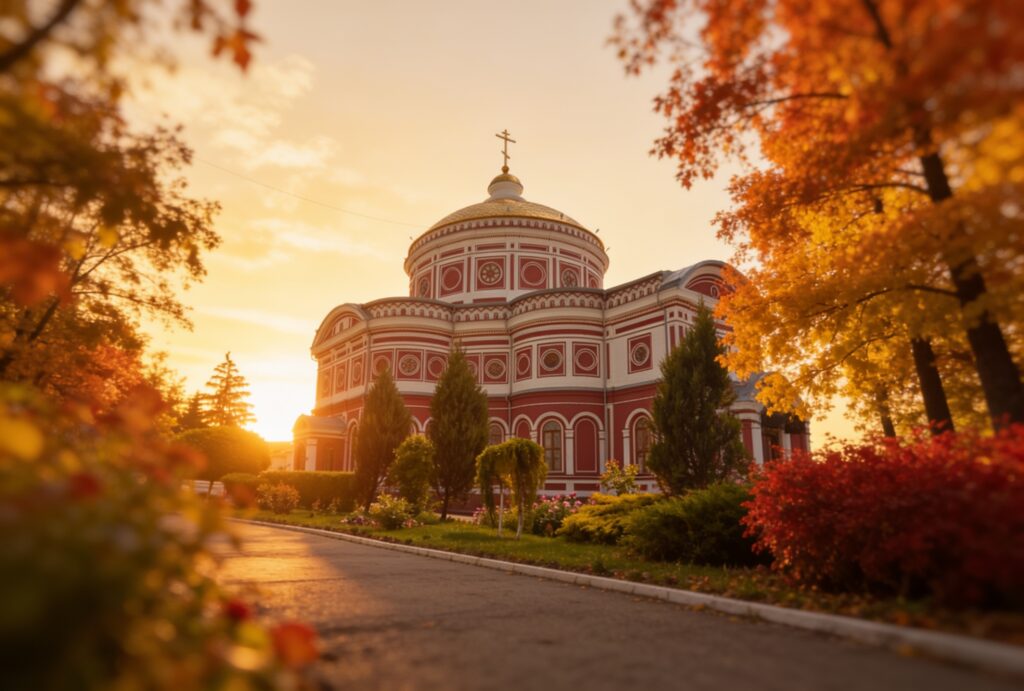
In the heart of Kursk, among the usual urban development, the eye suddenly rests on a monumental red brick building. Its powerful dome, as if floating above the bustle, reminds of those times when the silhouettes of temples set the rhythm of the whole city. Today, the Resurrection Church has regained its voice, but the path it has traveled is worthy of the pen of an adventure novel – there were national donations, years of oblivion, and a real miracle of industrial patronage.
The way from the cathedral to the factory warehouse
The history of this shrine is the history of two temples. In its place once stood the dilapidated Resurrection Cathedral, which was dismantled at the end of the XVIII century, when Kursk began to acquire the features of a regular city. The new temple, which has survived to our days, appeared thanks to the inhabitants of the city. In 1875, large-scale construction was launched here on the national money. The church was built thoroughly, for centuries, and a year later held a solemn consecration.
Interestingly, the temple was originally conceived as part of the monastery complex. He had three thrones, each of which had its own initiation. It was a real spiritual center, decorated with a rare luxury for a provincial city: the walls shone with marble, the iconostasis was made of noble stone, and the royal gates were cast with silver.
But the twentieth century treated this beauty cruelly. In 1923, the temple was closed, arranging a provincial archive in it. It seemed like a sentence. However, later the building was waiting for an even more prosaic fate: after the war, it was transferred to the Elektroaparat plant. The former church has a warehouse. In order to adapt the ancient walls to the needs of industry, the second floor was built inside directly under the dome, elegant semicircular windows were walled up, and the altar was turned into an ordinary shield. It seemed that the past spiritual life was forgotten here forever.
The Return of Life and the 20-ton Dome
The turning point came in the late 90s. The city authorities decided to return the church building, but the transfer process took years. Only in 2003 the temple officially found a new life. Surprisingly, the main patrons of the revival were those who once used it as a warehouse — the management of the Kursk Electric Hardware Plant. It became a symbol of reconciliation between history and industrial progress.
The most spectacular moment of recovery was April 2006. In front of many citizens, a new dome was erected on top of the temple. Its dimensions are amazing: 17 meters in diameter and weight 20 tons. This machine was manufactured in distant Volgodonsk, and the installation became a real engineering event for Kursk. The moment when the cross was again in its rightful place, many eyewitnesses call the point of no return – the temple finally returned to life.
Architectural character and discoveries of restorers
Today, the Resurrection Church looks exactly as it befits a monumental structure in an eclectic style. In its appearance, the Byzantine influence is felt, especially in the drawing of a massive cross crowning the central volume. Architects of the XIX century created a building that amazes with its integrity: brickwork, once only the basis for whitewashing, today emphasizes the nobility and power of the walls.
When the restoration began, the builders were waiting for surprises. It turned out that the building has a huge basement floor, which was forgotten over the years of factory operation. The height from the foundation to the windows here reaches five meters. To return the basements to their original appearance and clean them of centuries-old layers, it was necessary to remove thousands of cubic meters of soil. These works allowed not only to strengthen the foundation, but also to reveal new facets of the ancient building.
Today, having crossed the threshold, it is difficult to imagine that recently draft shops walked here. Services are again being held in the temple, and its restoration continues, returning the Kursk streets to the very vertical that has served as a moral guide for the citizens for centuries. This church became a symbol that even after the longest oblivion, a rebirth is possible.
Charity FundHoly Land.
Russian Temples and Monasteries