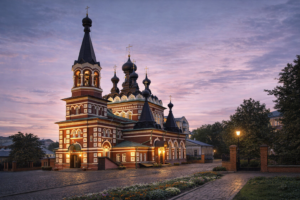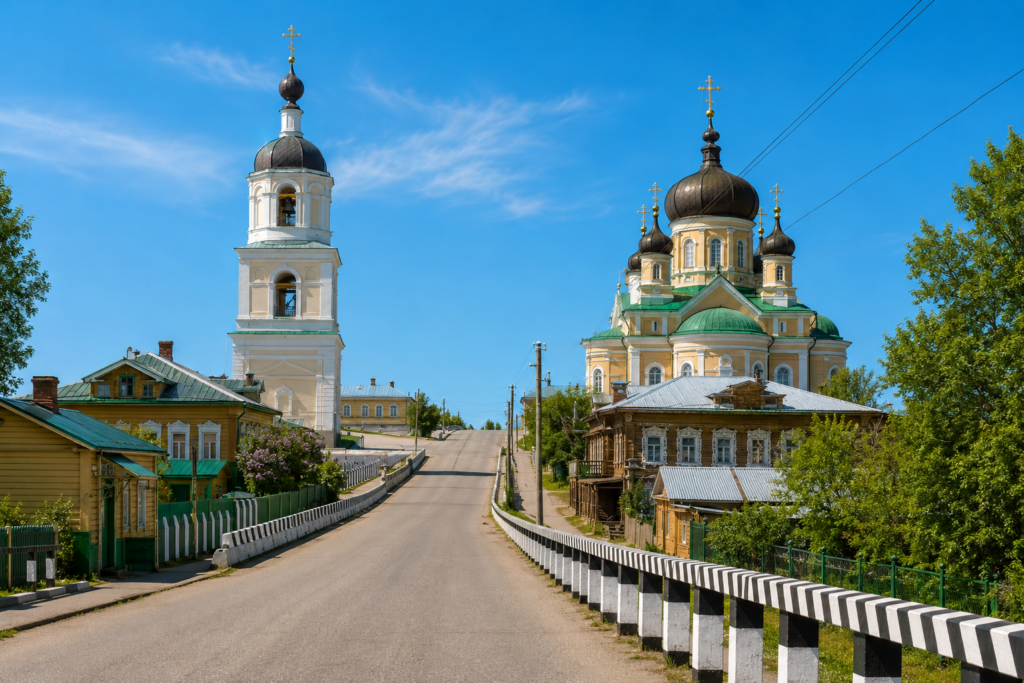
The quiet town of Petrovsk, located on the banks of Medveditsa, keeps a living memory of the Peter’s era. Founded in 1698 by royal decree, it almost immediately acquired its own temple. Imagine: the freshly cut walls of the fortress, the smell of tar and wood, and in the middle of this young settlement is a modest church in the name of Demetrius of Thessaloniki. She was destined to become the ancestor of the majestic stone cathedral, familiar to every local resident.
The wooden building, erected in 1699, lasted almost four decades and by 1738 was dilapidated. Instead, a two-storey church grew, where the upper tier took the throne of the Kazan Icon of the Mother of God, and the lower tier retained the dedication to St. Demetrius. However, the true birth of the architectural dominant of the city occurred later, in the second half of the nineteenth century.
From 1865 to 1871, on the donations of the merchants — the names of the Novichkovs, Shvetsovs and Tikhomirovs — a five-domed building was erected from stone. A key role in fundraising was played by a former parish cleric, the priest Magnusov. Thanks to his efforts, the eminent benefactor Turgenev joined the good cause, who contributed the lion’s share of the required twenty thousand rubles. So on the map of Petrovsk there was a spacious cathedral with a stone bell tower and a completely gilded iconostasis. Individual images were dressed in shining gilded salaries. The main altar was dedicated to the Kazan image of the Virgin, and in the side aisle the throne of the prophet Elijah was placed.
The parish life of the beginning of the last century was the key. Two priests, deacon and psalmists nourished not only the city, but also the remote farms of Zotovo and Sorokino, where church schools operated. Divine services, processions, children’s voices, teaching prayers – all this fell silent in the twenties. The temple was closed, and in 1936 the bell tower was blown up. The remaining room was turned into a military warehouse, and prayer seemed to leave the walls forever. But at the height of the war, on July 9, 1944, there was a long-awaited revival — the church was again consecrated. From that day on, the doors remain open despite any external storms.
Today’s temple is filled with creation. Wedged in 2013 and 2015, the domes shine again over the city, as if reminding of the miracle of rebirth. Here carefully keep the arks with particles of relics of amazing saints: Innocent of Moscow, Philaret, Ambrose of Optina, Alexander Nevsky. A special love is surrounded by the image of righteous John Olenevsky, to which pilgrims flow.
The parish has long exceeded the limits of exclusively liturgical space. Within the walls of Sunday school, children and adults voices sound, and the circles “Spiritual crops” and “Bells” fill life with creativity. The social worker and the catechist serve those in need. Under the care of the temple are chapels in the district hospital and in the city cemeteries, turning care into preaching by deeds.
In this uninterrupted passage of time, the temple remains a constant landmark. In its silence, where soldiers’ boots once rumbled, and now candles gently warm, there is a special breath of eternity. Petrovsky Cathedral, which passed through the destruction of the bell tower and oblivion, today is not just a monument of antiquity, but a living witness that the true shrine does not disappear while the hearts of parishioners beat.
Charity FundHoly Land.
Russian Temples and Monasteries