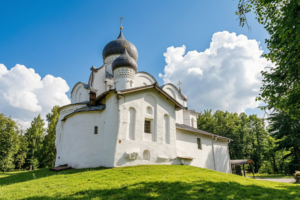
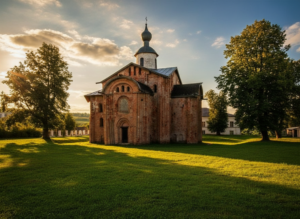
Imagine Moscow in the early seventeenth century. Behind the Earthshaft, among the Yamsky settlements, where the masters of the race lived, a wooden cage ascends to the sky. It was a time when the Rogozhskaya Sloboda was just finding its voice, and its first church, named in honor of Sergius of Radonezh, became the spiritual center for the Yamskans. The first mention of this wooden structure dates back to 1625. But fate has prepared this place to pass through fire, invasion and an era of disbelief, to shine again today with the gilded domes.
By the beginning of the XVIII century, the tree replaced the stone. By 1722 there was already a solid stone church with an elegant tent bell tower, which stood for almost a century and a half. The temple grew and changed with Moscow. At the turn of the XVIII-XIX centuries, the old one-sided refectory was dismantled, erecting a new one with two warm chapels in honor of Sergius and Nicholas the Wonderworker. And in 1818, the magnificent summer temple that we can see today appeared here.
The Patriotic War of 1812 was a cruel test for the church. The French soldiers who flooded the first throne did not spare the shrine: the temple was looted, and the ensuing fire destroyed the buildings. But the amazing detail — the church utensils survived. The parishioners, anticipating trouble, buried it in the ground, hiding it from the invaders. This ability to preserve the main thing among the ruins will be the leitmotif of the entire future history of the Sergius Church.
Located next to the largest center of Old Believers, this parish has always been distinguished by a special attitude to ancient piety. Here is a unique collection of ancient iconography. When in 1876 the artist A. S. Rogozhkin began to paint the walls, he probably realized that he was creating a masterpiece at the intersection of traditions. The atmosphere in the church was special: at the end of the XIX century, a special audience for interviews with Old Believers was consecrated here — a place where a difficult dialogue between the two spiritual traditions of Russia was born.
The twentieth century entered these walls like a hurricane. In the 1930s, a wave of arrests took place in the temple: the abbot, singers, active parishioners were captured. In 1938, the church, which had gathered believers for almost three centuries, was closed. What the French could not destroy, did the new government: a unique collection of icons disappeared irrevocably, crosses from the domes knocked down, and the building itself turned into a warehouse. Inside, where spiritual concerts once sounded, a sculptural workshop of the Art Foundation was housed in the 1980s.
The temple seemed to be lost forever. Energized drums, empty eye sockets of windows, painted iron instead of noble coatings — this is how he met the 1970s. But a miracle happened. In the mid-1980s, the building was transferred to the Andrei Rublev Museum. The restorers came here not with a pickaxe, but with skill. By 1990, as if manifesting from the darkness of the face, the temple has found its former appearance. And just a year after the return of the building to believers, in December 1991, the words of consecration again sounded over the main throne.
Today it is not just an architectural monument outside the Earth City. It is a living organism where children laugh from Sunday school and have publicity conversations. Looking at its walls, written by Rogozhkin, you understand: the story of Sergius in Rogozhskaya is the story of perseverance itself. Burning to the ground, being saved in the ground; having lost crosses, finding them again; having survived a time of desolation, becoming a center of attraction. This church survived centuries not because of, but in spite of, and now its silhouette in the east of Moscow reminds us that the time to destroy passes, the time to build – forever.
Charity FundHoly Land.
Russian Temples and Monasteries