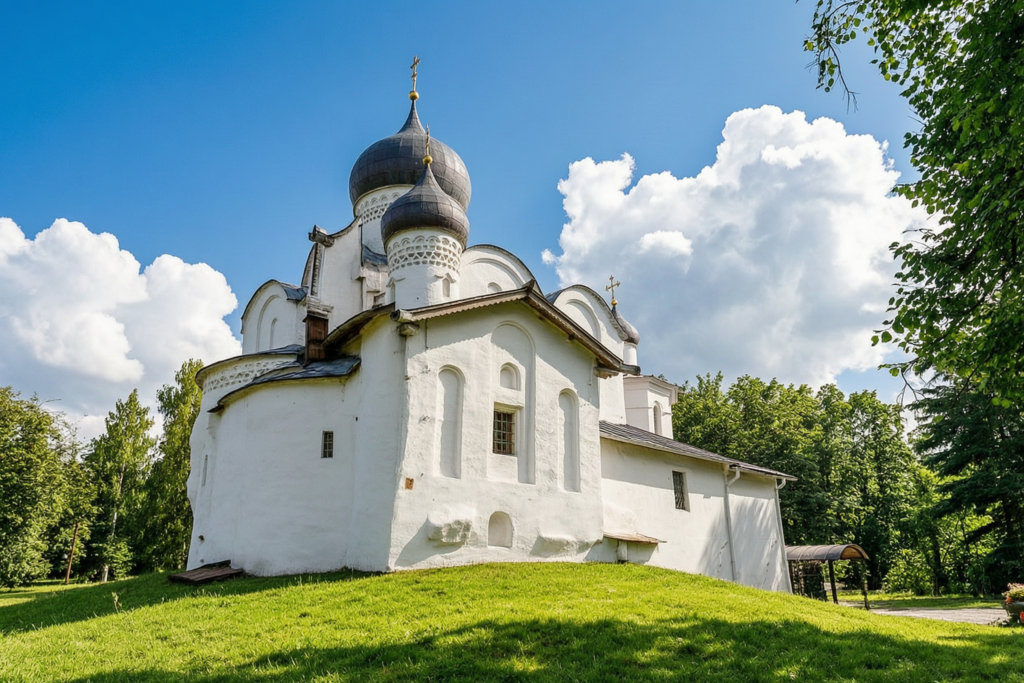
If you walk along October Prospekt in Pskov and turn a little to the side, the look of itself clings to a small but surprisingly assembled church. It seems to have grown out of the earth itself – not bulky, not screaming, but strict and attentive, like a sentry on duty. This temple of Basil the Great on Gorka is one of those Pskov temples, which are not so much striking in size as force you to stop and take a closer look.
Island over the swamp
Once this slide was a real island among the swamps. At its foot ran the river Zachka — now in its place Pushkinskaya street, asphalt and sidewalks, and then there was water, dampness, fog in the morning and a special silence, which happens only near the water. The place was not chosen by chance: it was noticeable and convenient for defense. In 1375, the wall of the Middle City was laid along the stream, and the Vasilievskaya Tower was put in front of the temple. There was a bell hanging on it, the one that raised the whole city in alarm. It is said that it was his hum in 1581 that warned Pskov about the approach of Stefan Batory’s troops.
The hill itself seemed to gather life around itself: here trade was boiling, people walked, bells rang, and even nature itself emphasized the importance of the place — an island among the water is always perceived as something reliable, as land that will not fail.
From merchant to stone temple
The history of the temple begins with a man who came here from afar. German merchant Christopher Karel Dol came to Pskov, converted to Orthodoxy and was baptized with the name Vasily — in honor of his heavenly patron. For him, this city became home, and he wanted to leave a mark here not in the form of goods or warehouses, but in the form of a temple. In the XIV century, a wooden church appeared on this place, and next to it another temple, in the name of the martyr Anastasia Rimlianitsa: Dol built it in honor of his wife and daughter.
In 1413, a stone church was erected on the site of a wooden church. It turned out not just a house for prayer, but a real fortress of stone — restrained, but very strong. Pskov masters were able to build so that the temple stood for centuries, withstand winds, sieges, and time.
How the temple works
The temple of Basil the Great is the pure voice of Pskov architecture, but other intonations are heard in it. In the ornaments on the apses and drum, the Novgorod motifs are guessed, and the way they are collected in triple ribbons betrays the influence of the Moscow school. This is a quiet dialogue of cities that can only be heard if you look closely.
The temple itself is four-pillars, with elevated spring arches. He has three apses, the main volume and two chapels: the north — in the name of righteous Alexis, the south — his own, special. To the porch leads a closed porch with a wide staircase, and above it is an octagonal tiered bell tower. Underneath all this is a vaulted subclet, a lower floor, like the roots holding the building.
The facades of the temple are separated by shoulder blades, tightened by semicircles. The apses are decorated with arcature — simple but expressive roller divorces. They are completed by an ornamental belt: a “runner” in the frame of a “rebellion”. The drum is cut through six narrow slit windows, and on top — a ribbon of ornament and an bulbous head with a cross. Everything here is done without excessive pomp, but with great attention to detail.
In 2002, when restoration work was going on in the basement, a “house” was found – a children’s coffin with the remains of a two-year-old child of the XVI-XVII centuries. The find reminded that behind each stone there is someone’s life, someone’s history, and the temple is not just a monument, but a place where these stories continue to live.
Trials and returns
The temple had a long and difficult fate. In the XV-XVI centuries it flourished: it was attached to the aisles, galleries, painted icons. One of the main shrines — the icon of the Tikhvin Mother of God with an akathist in 24 hallmarks — was painted at the beginning of the XVI century. Later it was built into the iconostasis, and now it is stored in the Pskov Museum-Reserve.
But then times got tougher. Since the end of the XVII century Pskov weakened, and the temple together with the city experienced decline. In the middle of the XVIII century, the belfry was converted into a bell tower — the same one that still stands today. In 1786, due to the small number of the parish, the church was attributed to the neighboring church of Nikola from Usoha. By the 1830s, the building was very dilapidated: the northern chapel collapsed, the ancient iconostasis and the carved choir disappeared. In the middle of the XIX century, the temple was repaired, but this repair changed its ancient appearance.
By the end of the century, the church became a farmstead of the Krypetsk monastery: once a year a procession came here, and the rest of the time the temple stood empty, as if waiting for something.
In 1921, the temple was closed and turned into a warehouse. During the occupation of Pskov in 1941, he was handed over to the Old Believer community of Pomor accord. In 1944, the northern part of the building was bombed. After the war, the temple was closed again, and the regional archive was placed inside.
The temple seemed to have no future. But it did. In 2003, the church was transferred to the community of the Russian Orthodox Church. Restoration work has begun. In 2009-2010, the Zakomar cover was returned, the chapter and covering of the northern chapel were restored. On December 3, 2003, a prayer was repeated here, the first service after a long silence. In 2007, nine new bells were consecrated, and the bell rang again over Gorka.
And in 2019, the temple was included in the UNESCO World Heritage List — as part of the complex of monuments of the Pskov architectural school. Now not only Pskovis know about it, but also people around the world.
Today’s day.
Now the temple lives a normal church life. Here come to services, put candles, ask for the most secret and just come to stand in silence. It still stands on its slide, as if guarding the city, as once guarded by its fortress wall and swaying bell.
Charity FundHoly Land.
Russian Temples and Monasteries