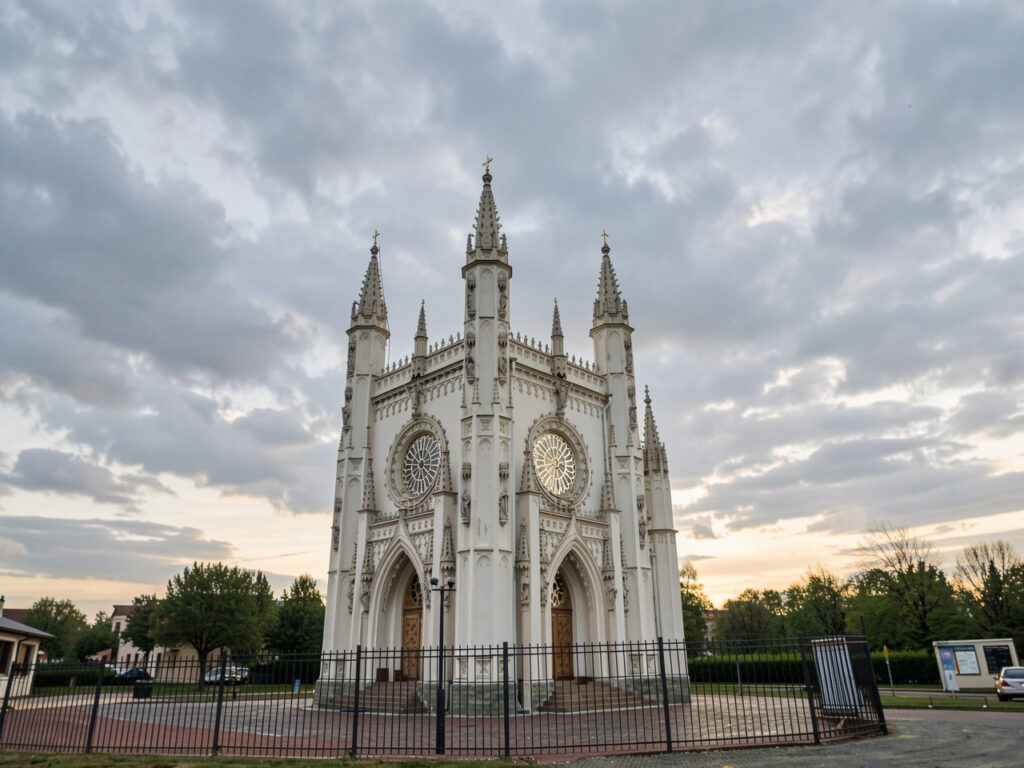
There are places that are confusing at first sight. You walk along the Peterhof Park among pine trees and linden trees — and suddenly, because of the turn, something appears that clearly came here from another century and another country.
Iron needles of spires, figures in niches, pointed arches. The hand reaches out to the guide: this is
Are you sure Russia?
Russia. One day, the emperor had to build a church for a woman who had grown up.
Another tradition.
Alexandra Feodorovna came to St. Petersburg from Prussia as a young princess, became a Russian
The empress, but the Gothic silhouettes of her native lands, apparently, remained a symbol of her home. When the health of the Empress was shaken and the doctors prescribed her peace and walks in the fresh air, Nicholas I came up with a gift that could only come up with a man in love with absolute power: he built a whole park for his wife in the spirit of German romanticism.
— with a cottage, alleys and a special atmosphere. The park was named Alexandria. And the park needed a church.
The order was given to the Berlin architect Schinkel, and he, judging by his own words, at first
I’m confused. «The task went beyond the usual,» he wrote. How do you build it?
An Orthodox church so that it looks like a Catholic chapel, but still remains Orthodox? Schinkel found the answer and for this he received membership in the St. Petersburg Academy.
arts.
Outside the building lives its own, almost theatrical life. Forty-three copper figures are placed on the facade — angels, apostles, evangelists, Our Lady and Child. The sculptor Demut-Malinovsky clearly enjoyed his work: the figures are not decorative extras, but full participants in the architectural action. Why forty-three, no one explained. That’s just what happened in the composition. This in itself is a bit fascinating: a grandiose structure without symbolic arithmetic.
Inside, the space narrows to a chamber space — seven meters wide, but almost twenty-two in height. You stand on a small spot and look up, where the nerves and stucco stars.
They cross. Stained glass cuts sunlight into colored stripes. The iconostasis is essentially Orthodox, but all braided with gothic gilded ornament – like two masters.
They worked side by side and neither gave way to the other.
Services here were held only in the summer and only for their own. One day, someone close to you.
The emperor sang on the choir with his children. Nicholas I, a stern military and statesman, sang in a tiny house church. This detail changes the idea of the place.
Then there was the revolution, the closure of the temple, its transformation into a museum, the war. From all the decoration.
Three icons and liturgical utensils survived — they managed to take them out. The icons returned to the place and hang there still: “Archangel Michael”, “Savior”, “Ascension”. The rest was restored.
Decades of photographs and archival data.
In 2006, the chapel for a few days became the place of return: here was the coffin of the Empress.
Maria Feodorovna, brought from Denmark eighty years after her death.
The story came full circle here.
Today it’s a museum. Divine services are rare here. But the chapel doesn’t impress.
A preserved exhibit. Rather, it is a private letter, accidentally made public.
There was no state religion, there was a family religion. And it still feels like that.
Charity FundHoly Land.
Russian Temples and Monasteries