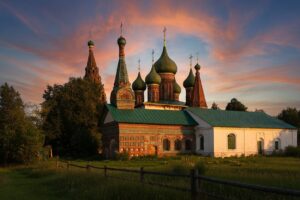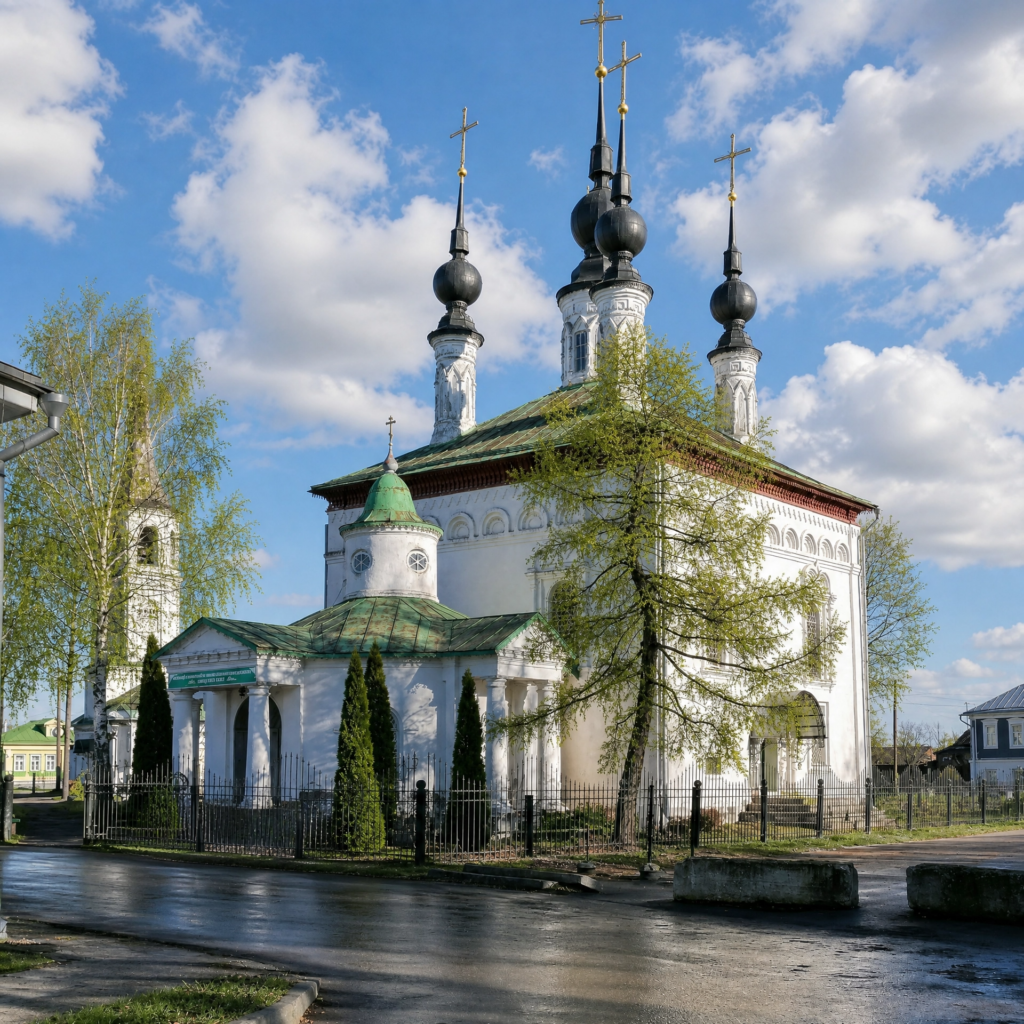
On the northeastern corner of Suzdal Trading Square, next to the ancient Gostiny Dvor, stands the temple ensemble, which has become one of the symbols of the city. The high five-domed summer temple of the Holy Equal-to-the-Apostles King Constantine and the elegant winter church of Sorrow with a tent bell tower form a composition that cannot be confused with any other.
Wooden beginning
For the first time, the Tsarekonstantinovskaya church is mentioned in the scribe book of 1617 — then it was wooden, «kletskoy», with the aisle of the Exaltation of the Cross of the Lord. The parish was small: 52 yards, about 300 parishioners. The wooden temple stood until the beginning of the XVIII century, but because of dilapidation it was dismantled. In 1707, a stone temple was built at the expense of parishioners — it wasThe last five-domed church built in Suzdal.
Architecture
Tsarekonstantinov Church — a modelrussian. The pillarless high four complete five bulbous chapters on elongated thin drums with an arcature belt. Such «intricate» heads in Suzdal no longer. White walls are generously decorated with a cornice of horseshoe-shaped kokoshniks, belts of jagged towns and balusters, windows with carved keel-shaped casings. The decor reveals similarities with the decoration of the Trinity Cathedral of the Rizopolozhensky Monastery — perhaps the temple was built by the same masters.
In the first half of the XIX century, the western side appeared.poppert. Despite the difference in styles — the narrowness of the XVII century and the classicism of the XIX — it organically fit into the composition.
Nearby is the steamy winter Sorrow Church (1750) with a chapel of nine martyrs of Cyzics and a bell tower with a typically Suzdal concave tent-«duka».
Closure, division and rebirth
In 1923, the temple was closed. The building arranged a warehouse of linen, then a garage, and later a public toilet. By the time the church returned in 1976, the temple was in ruins.
In 1990, Archimandrite Valentin (Rusantsov) with the parish left the Moscow Patriarchate, and the church became the cathedral of the self-proclaimed “Russian Orthodox Autonomous Church”. This period went down in history as the Suzdal split.
In 2009, the Arbitration Court decided to seize the temple from the RPAC. In December 2010, the church was transferred to the Vladimir Diocese of the Russian Orthodox Church, and on January 7, 2011, the first liturgy took place in the jurisdiction of the Russian Orthodox Church.
Charity FundHoly Land.
Russian Temples and Monasteries