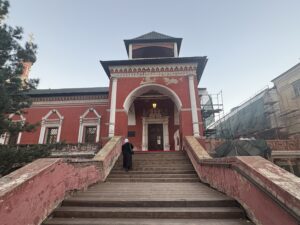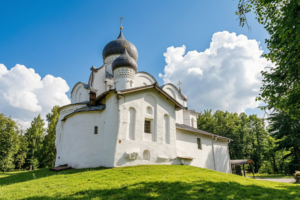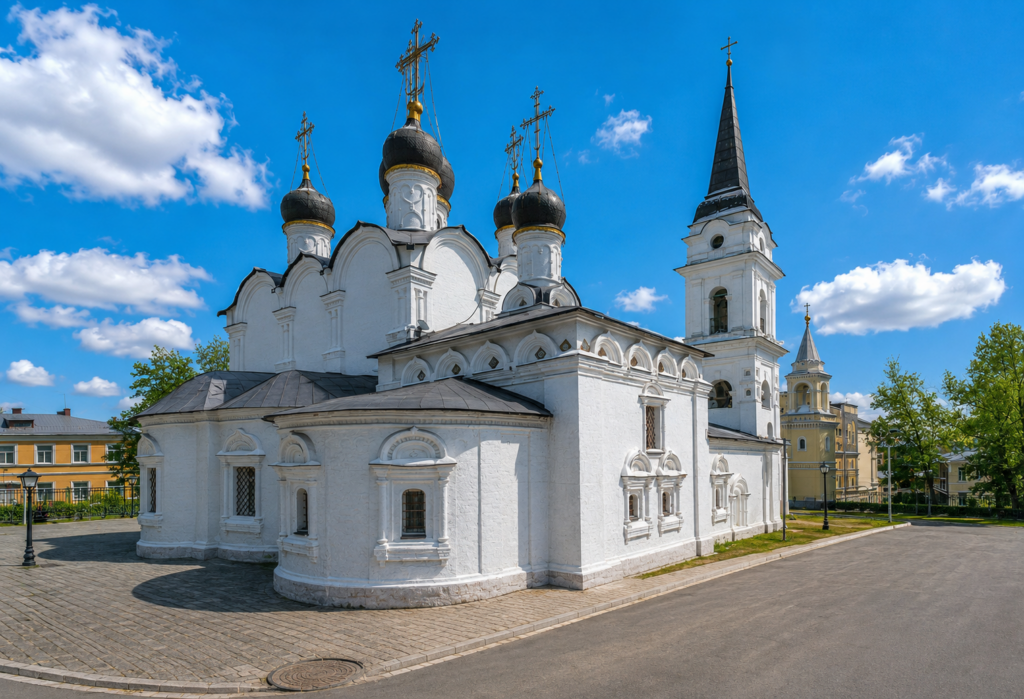
The pedigree of this place is truly powerful. Born between 1407 and 1417 as a modest wooden church at the country yard of Dmitry Donskoy’s son Vasily I, it kept the peace of the summer residence of Moscow rulers. But the real grandeur of the walls gained a century later, when the Italian Aleviz Novy entered the business. The same architect-fryazin who decorated the Kremlin with stone lace, at the behest of Vasily III, erected a brick palace cathedral here instead of a dilapidated tree. In 1516, the temple was consecrated, and the area forever cemented the poetic nickname “Old Gardens”.
Walking around the church today, it’s hard to imagine that it has survived a series of tragedies that could wipe away any memory. The temple, rebuilt in the lush forms of Moscow’s patchwork in the XVII century, stood up again and again after devastating fires. Especially terrible was the year 1812 – Napoleon’s flame almost destroyed the parish, leaving only a charred skeleton, which was almost dismantled as unnecessary. Salvation came from the real state adviser Mikhail Volsky. Amazed that the only church in the name of the Baptist of Rus may disappear in Moscow, he brought the shrine back to life on his own coshta.
However, the bloodiest pages are inscribed in the history of the monastery by the twentieth century. It is enough to linger on the iconostasis to feel the invisible presence of the host of martyrs. From here, from the walls of the Vladimir Church, the Hieromartyrs Alexander Pokrovsky and Vladimir Ambartsumov went to the execution in Butovo. Their abbot, Father Sergius Bordelius, and completely accepted a brutal death in the dungeons of the Butyr prison exactly on the feast of the Annunciation. In 1933, the Bolsheviks knocked down the doors, and later ruthlessly beheaded the domes. Ostrov stood in ruins until the Olympics-80, when a timid restoration began.
And yet the temple rose again. In May 1991, on the day of commemoration of Cyril and Methodius, the liturgy was resumed here. If you look here on September 11, you can witness an amazing echo of antiquity: once on the day of the Beheading of the head of John the Forerunner, the square in front of the church turned into a noisy market. The peasants carried wool on hundreds of wagons, and the priests managed to serve up to eight hundred short prayers in two days. The worshipers carried with them tiny red threads from the decoration of the analoy — as a sign of memory and hope for intercession.
Today, the temple of Prince Vladimir has again become an indestructible beacon of faith, where history quietly rustles under the peaceful chime of the restored bell tower. This is a living testimony that even through the ashes of fires and the blood of the New Martyrs, eternity grows. Here, among the stones that remember the kneeling patriarchs and kings, the prayer for the “authorities and armies” is not interrupted for a moment.
Shrines
- Icon of the Mother of God “Healer”
- The revered icon of St. Nicholas of Myrlicia with a particle of relics
- The revered icon of the Monk Martyr Grand Duchess Elizabeth with a particle of relics
- Icon of the Holy Princes Peter and Fevronia with a particle of relics
- Icon of the Hieromartyr Zinovius and Martyr Zinovia with a particle of relics
- Icon of St. Sergius of Radonezh with a particle of relics
- Icon of St. Seraphim of Sarov with a particle of relics
Charity FundHoly Land.
Russian Temples and Monasteries