Imagine the damp Moscow autumn of 1655. The masons lay the last bricks, and the sovereign of all Russia is already hastening the isographs. In the summer of 1656, artels are gathered here: Yaroslavl people carry recipes for mixing colors, Kostromachi — a special manner of writing faces, the monks of the Trinity — strict learning. At the head of this artistic expedition are three: Simon Ushakov, whose brush gave birth to luminous images, Joseph Vladimirov, a theorist and practitioner of “lifelikeness”, and Fyodor Kozlov, the royal isograph. They create a painting that is breathtaking. But the temple is silent: Nikon will never cross his sanctified threshold. The frescoes are doomed to disappear into oblivion along with the plans of the disgraced patriarch.
Years later, Joachim takes over. He redraws the space, invites new masters and puts a point in September 1681 – the temple is named after the Twelve Apostles. It was then that the altar barrier gets an unprecedented completion: a carved crucifixion rises above the icons. Until then, no Russian temple knew such a composition. The detail, which today seems canonical, was born as a daring experiment here.
Centuries have spared the building. Under Peter he was cut with wooden decking — a book depository was built at the top, and volumes hung over the throne in heavy bindings. The architect Chichagov in the XIX century received a laconic order: “to make light”. And the masters mercilessly widened the windows, cutting down part of the exterior decoration. In the twentieth century, the iconostasis migrated here from the blown up Ascension Cathedral – an alien, but surprisingly beautiful element.
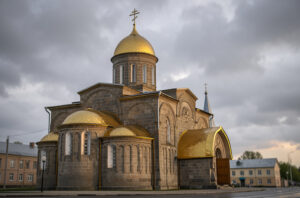
Look at the north facade. There is a bunk porch with colored tiles — it seems as if it grows directly from the wall. A little higher, on the drums, a columned arcature is read — hello from Vladimir-Suzdal Rus, deliberately quoted by the builders. And if you raise your head inside the central drum, you can distinguish fragments of painting of the late seventeenth century. This is not a reconstruction – this is an authentic layer of time, unveiled by the restorers in 1978.
Today, the temple does not sound like a prayer, but continues to preach – the language of art. Within its walls is collected iconography of the seventeenth century: the Moscow school with its gravitation to realism and provincial letters, which retained a severe spiritual expression. And above the throne flickering tent gilded shadow, restored a quarter of a century ago, as an echo of the first, and not happened consecration under Nikon.
Charity FundHoly Land.
Russian Temples and Monasteries