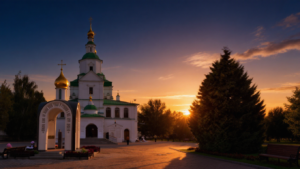
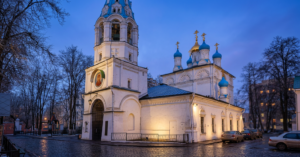
If you go from Kostroma to Galich, among the usual Central Russian landscapes suddenly opens a hill, as if ingrown into the sky with its domes. This place keeps the memory not only of prayers, but also of prophecies. Long before the monastery bell sounded here, Elder Eupraxia lived on this hill. It was said that she had a special gift: she foresaw that it was here, on the land of the Varentsev landowners, that a female abode would one day arise. She died in 1823, but her words proved prophetic. Exactly half a century later, in 1874, the first novices came here.
The foundation of the monastery became an act not so much of church zeal as of mercy. The last owner of the estate, Elizaveta Nikolaevna Varentseva, did not build a luxurious patrimony. In 1870, she opened an almshouse for single women and an orphanage for orphaned girls. The desire to help the disadvantaged grew into the creation of the New Trinity Women’s Community. In the people, this place was quickly christened Sumarokov – after the name of the ancient village, and the monastery itself was loved for the quiet joy that the suffering people found here.
The heyday of the monastery came at the end of the XIX century, when the community received the status of a communal Holy Trinity Monastery. At this time there was a large-scale construction. The main pearl was the five-domed cathedral in honor of the icon of the Mother of God “Swiftly Obedient”. It was erected all over the world: the sisters collected donations, and the peasant widow Anna Kiseleva gave the monastery a bell weighing almost 219 poods. He was heard calling out to the faithful.
But the most amazing thing in the architecture of this place is not only the majestic cathedral, but also the old Trinity Church, built in 1849 on the very place where the cell of Elder Eupraxia once stood. The temple was erected directly above her grave, having arranged a subclet. This is a rare case when the story of one person is so firmly intertwined with the fate of an entire monastery. Under these vaults later found eternal peace and the founder Varentseva and her children.
The interior of the monastery was created for years. The special love of sisters and parishioners was enjoyed by the image of the Mother of God “Swiftly Obedient”, donated by Hieroschemonakh Partheny in 1888. By 1919, the monastery became one of the largest in the province: more than 240 inhabitants lived here. Life in it obeyed a strict rhythm. Ascent at 5 a.m. was followed by prayer and then labor. The sisters themselves worked almost 50 dessiatines of arable land, worked in the garden, in the cattle yard, but at the same time crafts flourished in the monastery. Here sewed vestments, painted icons, weaved canvases and even engaged in carpentry. Holiday was considered a sin, but every free minute was devoted to reading spiritual books.
With this abode are connected the fate of amazing ascetics. Mother Vera carried her cross here (in the schema of Michael), who walked barefoot in any weather, and her prayers attracted up to a thousand people to the temple on holidays. There was also a place for a miracle: at the grave of Elder Eupraxia, memorial services were served annually, and faith in her progeny was passed down from generation to generation.
The 1917 revolution changed everything. The monastery tried to survive: in 1919 it was registered as an agricultural commune, then a nursing home was opened, and later a state farm where the sisters were forced to work for hired labor. But the monastery did not surrender without a fight. On May 28, 1921, a commission arrived in Sumarokovo with a closing order. Peasants and nuns defended the cathedral with a wall, refusing to give the keys. It was the last act of resistance. Soon the temple was sealed, and the monastery was liquidated. Since 1939, a boarding school for the elderly has been located within these walls — so the circle of mercy started by Varentseva closed, but in a different dimension, far from faith.
Today, looking at the eastern facade of the temple «Swiftly», it is difficult to imagine that once there was a life of a huge community. But time has no power over the main thing. The silence on this hill is still special. And if you listen, you can feel how the echo of ancient songs mixes with the whisper of herbs — where once walked barefoot Mother Vera and where the prophecy of an old woman who saw the monastery long before her birth was fulfilled.
Charity FundHoly Land.
Russian Temples and Monasteries