Nalchik is a resort city, green, with parks and mountains on the horizon. An Orthodox church here is not the first thing that catches the eye: mosques, boulevards, sanatoriums — that is what defines the face of the city. But if you go to Pyatigorskaya Street, to the old cemetery, you will see a dome with an eight-pointed cross and walls painted with frescoes. The Temple of Simeon the Pillar. He doesn’t stand in his original place, and that’s his story.
Regiment and fortress
In 1826, at the Nalchik fortress, on the northern slopes of the Caucasus, the Kabarda Jaeger regiment was quartered. Soldiers and officers needed a temple – not a chapel, not a camping tent, but a real church where you can serve the liturgy, baptize children, and funerals for comrades. The wooden church was built quickly: it was cut from a timber, as they did on the Caucasian line, where the tree was, and the stone was not always. Regimental church, regimental priest, regimental life. Soldiers came, prayed, went to the mountains, returned — or never returned.
In 1843, the regiment withdrew and left. The fortress was no longer advanced: the border moved further south, Russian fortifications advanced deep into the Caucasus. But next to the fortress grew a village – ordinary, mixed: Russians, Kabardians, immigrants. The wooden church was transferred to the village — it became a parish church. It stood as it stood, and probably would have stood for a long time, if not for one person.
Hlupin and his brother
Captain Vasily Khlyupin is a prominent figure for these places. In baptism he was called Simeon, and Simeon the Stylus was his heavenly patron. Khlupin served in the Caucasus, rose to major-general, saw war and disease. His brother, Semyon Ilyich Khlyupin, was the head of the Caucasus Line Center, one of the chief administrators of the Russian presence in the region. Semyon Ilyich died in Nalchik of cholera. Epidemics in the Caucasus were commonplace: mountain water, heat, crowded troops – cholera mowed people down as regularly as bullets.
Vasily decided: on the site of a wooden regimental church it is necessary to put a stone church in memory of his brother. According to some reports, he bequeathed personal funds for this. He received the highest permission of Emperor Nicholas I, and nothing was built in the Caucasus without such permission. In 1851 the stone church was consecrated. Twenty-ninth of December, in winter, in the cold. The main throne is in the name of Simeon the Stylite, a saint whose name both brothers bore. One is alive, one is dead, and the temple is in between.
The stone church stood in the center of Nalchik, which was slowly turning from a fortress into a city. The parish grew, parishioners increased, services went. That’s seventy-plus years.
Disassembly
In 1928, the Kabardino-Balkar Regional Executive Committee decided to close the church. There are two reasons. First, the building interferes with the reconstruction of the central part of the resort city. Nalchik became a resort, and the authorities wanted space, boulevards, sanatoriums, and not a church in the center. Second, there was no mosque in Nalchik, and the authorities decided: if the temple is closed, why not give the land for the mosque? Logic is not without grace: close one to open another, and please everyone at once. You didn’t please anyone.
The parishioners resisted. We sent a delegation to Moscow – to the Synod, to the highest authorities. Wrote letters, asked, begged. Didn’t help. In December 1928, under the pretext that the temple will be “transferred”, the building was actually destroyed. They didn’t, they did. Some of the building materials were taken to the city cemetery, on the outskirts. Brick, stone, beams — all that survived during the dismantling. The rest remained in the place where the temple stood.
Interestingly, the authorities formally offered believers to move the temple at their own expense. The believers agreed. But the “transfer” turned into destruction: to move the stone church, it must be dismantled by brick, and then reassembled. Disassembled. They didn’t have time to collect, or they didn’t. So the promise was fulfilled halfway: the first part — to disassemble — fulfilled, the second — to collect — forgotten.
Prayerhouse
The believers did not give up. With their own money, next to the cemetery, they began to build a temporary house of prayer, a small, modest one. According to the old-timers, a cemetery chapel used to stand on this site, and it became the basis of a new building. In the report of the beneficent for 1928 it is written differently: the community built a temporary building from scratch. By the end of 1928, there were services in the house of prayer. The last one is December 2. Then a break.
In 1929, the prayer house was completed. But he did not serve for long: on the twentieth of April 1940, the Supreme Council of KBASSR decided to close it. Closed again. Again, the believers were left with nothing. War, occupation, liberation. Nalchik was occupied by the Germans at the end of 1942 — not long, but enough for life in the city to stop.
Return
In 1943, after the liberation, a group of believers applied for the registration of the Orthodox community. The Nalchik City Council concluded an agreement: the church council was given the premises of the prayer house near the cemetery for unlimited free use. Not the one destroyed in the center, but the new one, small, on the outskirts, next to the graves. This is where the modern temple grew.
The building was gradually expanded. To the 1000th anniversary of the Baptism of Russia – it was 1988 – an additional throne was consecrated in the southern wing in the name of the great martyr and healer Panteleimon. Panteleimon is a holy healer, and in the resort city this dedication sounds especially: people come to be treated, and the temple heals in its own way.
What’s inside
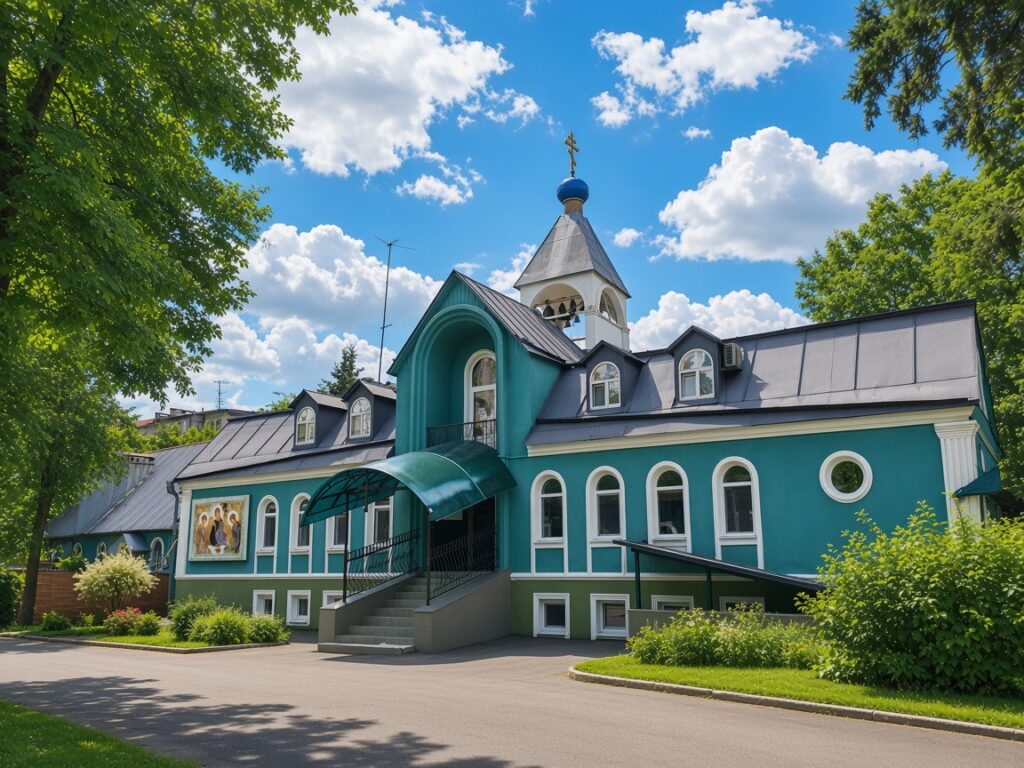
The modern temple consists of three parts: the altar, the temple itself, the porch. The dome is one, with an eight-pointed cross. Inside are frescoes of the end of the XX century, written in the traditions of Russian icon painting, according to biblical subjects. Some of the artists relied on Vasnetsov’s paintings – and this is noticeable: the same colors, the same poses, the same craving for the epic. On the southern wall there is the prophet Elijah, Saint Panteleimon, the icon of the Mother of God “The Sovereign”, the Assumption of the Most Holy Mother of God. In the western part there is a balcony for the choir, and under it there are also frescoes. The temple is small, but the whole is painted — there is nowhere to rest, everywhere the face, plot, inscription. In the temple there are relics with images of different saints.
There is a Sunday school at the temple. Divine services – daily: day liturgy and evening. The living temple is not a museum, not a monument, but what it was built for: a place where people pray.
Charity FundHoly Land.
Russian Temples and Monasteries