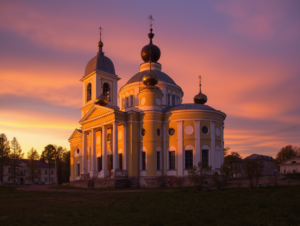
For a long time, the Assumption Church was the cathedral of the eponymous monastery. The time of the monastery’s origin is unknown, the first written memories date back to 1649. At the site of the current cathedral, there was first a wooden church, in the 18th century it was replaced by a stone temple. Over time, it became dilapidated and rebuilt.
The cathedral we can visit was completed and consecrated in 1902. It is two-story, with two thrones on the lower floor and three on the upper. The painting of the upper church exactly repeats the frescoes of the Vladimir Church in Kiev, painted by Viktor Vasnetsov.
The walls of the cathedral are made of red brick, the heads are black. For this reason, the church is sometimes called the “black temple”. There are versions about the connection of such temples with Freemasonry, but these are just another “conspiracy theory”. In fact, the black color of the domes means that the temple is monastic. In addition, it is dedicated, albeit festive, but sad event — the Assumption of the Virgin. Black is the color of renunciation of the world, mourning for a past life.
After the revolution, the monastery was closed, the cathedral was tried to blow up. The laying withstood and then decided to remove the keys and use the building for the archive. Archival documents were stored there until 2005 (officially returned to the church in 1998), after the archive finally moved out, the building was repaired. The temple was opened to parishioners on the 860th anniversary of Tula, in 2006.
Now the cathedral is a cathedral of the Tula diocese.
Charity FundHoly Land.
Russian Temples and Monasteries