When Rear Admiral Fyodor Klokachev arrived to equip the southern borders of the empire, his flagship ship still smelled of fresh tar. The salvos of the war with the Turks of 1768-1774 had just died out, and the sailors of the Azov flotilla were in dire need of not just a coastal base, but a special sacred center. The naval commander appealed to Archbishop Eugene of Slavensk with a request to build a church dedicated to Nicholas the Wonderworker on the territory of the port. The permission was given quickly, and the choice of the site became a symbolic gesture: the builders cleared the very spot where the tent of Peter the Great was located decades before, who inspected Cape Tagany Rog for the construction of the fortress.
Carpenters and masons worked sporadically. Already in 1778 the new building was consecrated. Despite the wooden walls, based on a solid stone foundation, the building looked impressive and at first even wore the status of a cathedral — until the city acquired the Assumption Cathedral Complex. The core of the parishioners was the people of the sea: flotilla officers, port employees, fishing artels. The first abbot was Priest Isidore Lyakhnitsky, transferred here from the Voronezh diocese.
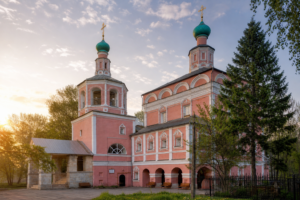
In the middle of the XIX century, the silhouette of the church was supplemented by a slender brick bell tower about three tiers — it was built in the name of the Great Martyr Paraskeva, adding also an extensive refectory. The proportions of the building followed the classical canons, and Empire handwriting was read in the decor of the tiers. However, fate prepared the ensemble for severe trials. During the artillery shelling of Taganrog by the Anglo-French squadron on May 22, 1855, two enemy shells pierced the southern wall. They did not receive any warnings, but they did receive a warning.
The worst blow came from the flames. During the fighting on the Eastern front, in 1941, the wooden body of the temple burned to the ground. Sixteen years later, a state campaign against religion completed the ruin: the top of the bell tower was destroyed by explosions. The surviving fragments were adapted for warehouses, stables, a carpentry shop and a mechanical workshop — by the end of the Soviet era, the believers were actually returned to the ruins.
Revival took place in the early nineties. The design bureau “Special Restoration” developed a plan that allowed to recreate the bell tower and erect new brick volumes to replace the lost building. The internal device was immediately thought out so that the premises could be reoriented to full-fledged services. In parallel, the abbot Alexander Klyunkov gathered a team of qualified icon painters: they covered the planes of the walls with paintings, carved a carved iconostasis, filled the kiots with images of different formats.
Within the walls of the temple are the relics of St. Paul of Taganrog, whose prayerful life was once intertwined with the parish. Since childhood, Anton Chekhov has been here: together with his relatives, the future writer brought out parties of church chants on the choir. And the legendary naval commander Feodor Ushakov attended the service in those years when he wore the officer’s uniform of the Azov flotilla, not yet suspecting of the future holiness and admiral laurels. The monument of history and architecture of the XVIII century today is not just standing in its former place — it breathes again, like a ship returning from a dangerous hike to its native harbor.
Charity FundHoly Land.
Russian Temples and Monasteries