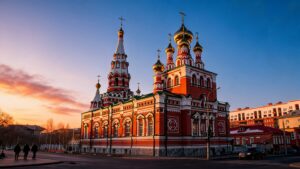
The quiet streets of the Tver Silence hide a building with a broken fate. It stands as a feud, not protruding its greatness, but a rare passer-by will not hold his eyes on it. So looks the last temple in the city, which was built by the inertia of the outgoing Baroque fashion, but breathed new, classic air.
Long before the appearance of stone walls, this place was prayed for. Even in the twilight of the Time of Troubles, before the great upheavals, two wooden predecessors huddled here — Athanasievo-Kirillovskaya and Mininskaya. The eldest of them disappeared without a trace, dissolved in the centuries so quietly that there was not even a meager record of the disassembly. But the fate of the second decided a pragmatic decree: by 1794, the dilapidated log house was ordered to be fired bricks. From the same brick and rose a new volume — like a phoenix mixed in the ashes of his own past.
Looking at the temple today, you see the conflict of epochs frozen in stone. The masters, who took up work in 1805, still thought of the categories of lush decoration: they “planted” a giant eight on a modest four-piece, and the altar wall gently curved outward. But time dictated rigor. The shoulder blades were dressed in rust, the openings were stretched out with strict rectangles, and the white stone of the base and details lay with a cold, aristocratic note. This building never became symmetrical: first the bell tower grew from the west, much later the northern side was warmed by a chapel in honor of the Introduction of the Virgin — it was added at the request of parishioners in the middle of the XIX century.
The inner life of the parish had its own heart rhythms. The main summer holiday — Ilyin Day — splashed out behind the walls with a procession of the cross. The procession stretched to Konstantinovka, where there was a simple wooden chapel. And in the temple itself rested relics, before which the heads of a generation bowed: the image of St. Nicholas with particles of relics and the icon of John the Merciful.
In the twentieth century, the place spoke differently. The bells were silent, and the vaults took into their bowels the local history museum. Cannons, mail, woven vestments, fragile tiles — all this was mixed here in a strange symbiosis of the sacred and worldly. The real tragedy came with the war. The front rolled to Tver, and, leaving, the occupiers set fire to the building. The dome collapsed while burying the collections. Immediately after the liberation, the museum staff, like archaeologists in the rear, extracted from the rubble burned iron and surviving church utensils. And much later, in 2012, the good looted by the Germans returned from Germany with a bizarre greeting from the fiery past.
From the former ensemble remained a torn skeleton. But in 2006, a cross shone again on the dome. Today, attributed to the Catherine Monastery, this temple is not just the architectural accent of the area. It’s a tuning fork tuned to the frequency of unshowed faith. Under its renovated vaults, prayer sounds again, quietly, but with the dignity that is given only through great losses and the long-awaited return to the light.
Charity FundHoly Land.
Russian Temples and Monasteries