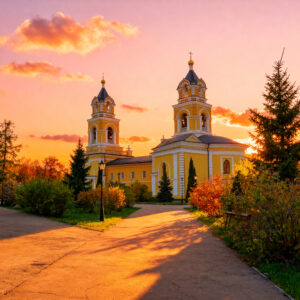
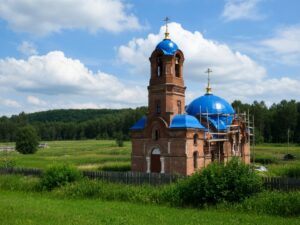
The thick smell of tar and sun-heated wood shrouded everyone who crossed the threshold of a small church in the village of Long. Outside, its walls were cast with a thick scarf — so the people dubbed the temple simply and spiritually: The Red Church. Behind this color was not a whim, but the living need of ordinary people, for whom the way to the Korensk monastery was long, and the heart asked for prayers nearby.
It all started with the 1756 petition. The monks of the Nativity-Theotokos monastery together with the peasants of Long, Budanovka and Tazov beat their brows about allowing them to build their parish. Fourteen years later, in April 1770, the temple in the name of Joachim and Anna was consecrated. A nice quadrangular log house, collected from different rocks, became the point of attraction of the district.
Time passed, and by the middle of the XIX century, a stone giant rose on the site of the dilapidated wooden shrine. Money for the construction was given by philistine Ivan Alekseevich Voronin, and embodied the idea of the “exemplary” project of Konstantin Ton. The construction proceeded in two waves: first the main volume, crowned with five chapters in the Russian-Byzantine spirit, then a spacious refectory joined it, and a three-tiered bell tower rushed upwards. There was also a stone school nearby.
The dashing year of the 1930s left a wound: the temple was closed, the small domes were ruthlessly dropped. In 1988 the building was returned to the faithful. It was as if ancient icons and utensils were waiting for this hour to fill the space with quiet light again. Today, the church is fully revived: its restored pentadium whitens over the greenery, and the ringing of bells, like a century and a half ago, spreads over the former Red Church, connecting the past with the present day.
Charity FundHoly Land.
Russian Temples and Monasteries