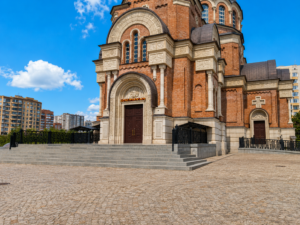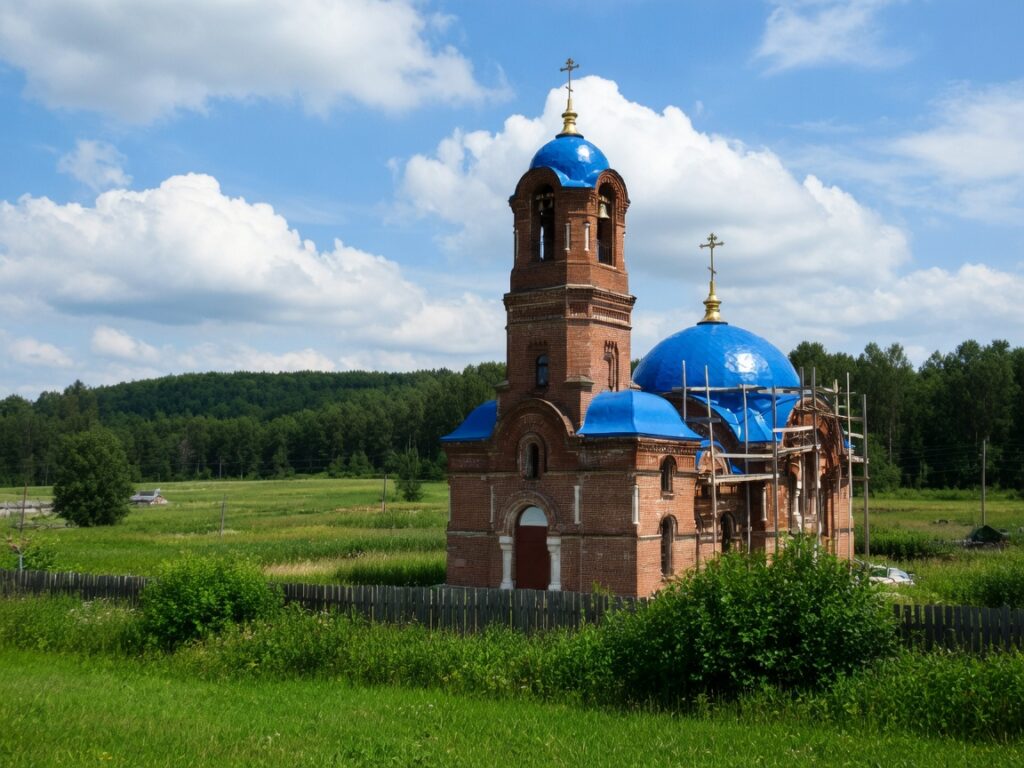
In the southern Urals, where the steppe is almost Kazakh, and the air smells of wormwood and hot stone, stands the village of Krasnokamenka. They didn’t call it that for the sake of beauty – it’s really full of red stones: ironed slates that stick out of the ground like the ribs of an ancient beast. The village is small, the streets are dusty, the houses are squat. And in the middle of all this is a temple. White marble, dome, bell tower. It stands like a stranger on this street — too elegant, too urban for a village where cows wander along the sidelines. But he’s his own. Because it was built by the hands of those peasants whose descendants are now walking by.
Why does the village need marble?
Construction began sometime between 1910 and 1914 — the exact date is lost, local archives are sparse, and generations’ memory is no different. The work was led by a foreman from Miass — the name was forgotten. Icons and utensils were brought from Miass and Chelyabinsk, the priest was also called from the city. But they did, all over the world. On the money of the village society, on men’s hands, on women’s eggs.
Eggs are not a metaphor. In the mortar on which the brick was laid, eggs were really driven — an old peasant technique known throughout Russia. Protein and yolk worked as a plasticizer: made the solution more elastic and stronger. And it worked. The laying costs more than a hundred years, and the brick takes neither rain, nor frost, nor time.
But the most amazing thing is not a brick. The most amazing thing is marble. The facades of the temple are decorated with snow-white Coelgin marble from local deposits. The same stone that lined the Moscow metro stations and the Cathedral of Christ the Savior. Koelgin marble is small, crumbly, easily polished to a matte shine. It looks natural in Moscow. In a village in the southern Urals — unexpectedly. It’s like someone bringing a porcelain cup to the haymaking. But that’s what makes the temple special: it doesn’t look like anything else. He is a stranger and at the same time his own, like a man who went to town, came back and brought something with him that had never been seen before.
Architecturally, the temple is a neo-Byzantine style. A cubic volume covered by a spherical vault and topped with a single dome. From the east there is a semicircular apse, from the west there is a refectory and a porch. Nearby is a two-tier bell tower. Neo-Byzantine style in the Russian province is a rare phenomenon. He demanded knowledge, money, and material. The Krasnokamensky peasants had neither architectural education nor capital budgets. But there was marble, local, underfoot. I was determined to build not just a church, but a beautiful church.
Consecration and re-consecration
The temple was consecrated in the name of the holy apostle and evangelist John the Theologian. Then — the exact time is unknown — re-consecrated in honor of Archangel Michael. Why it was re-sanctified is also unknown. Perhaps the feast has changed, perhaps a new chapel has appeared, perhaps something happened to the icon. Locals call the temple Michael-Arkhangelsk, in official documents it passes under both names. It is enough to know: it is the same temple, and it has two names, like a man who was called one in childhood, but he grew up and became another.
Five bells.
The temple did not last long. According to some reports, it was closed in 1919 — one of the first in the area. Others, 1929. The difference is ten years, but the essence is the same: this temple did not sing for long. There were five bells. All dropped. Where they went is unknown. Maybe they melted it down, maybe they took it away. The bell is empty.
The building was put into storage. Grain, bags, mice, dust. Then a homeless shelter. The altar part was overgrown with mud and webs. Dome tech. The plaster was coming off in pieces. When the building needed repair, it was not repaired – it was abandoned. So it stood: a white marble temple with a failed roof, in which no one went except homeless people and stray dogs.
For about a hundred years, peasants saved up for this temple, built it, drove eggs into solution, carried marble, erected icons. And for about a hundred years he stood without service. Brick held on. The marble didn’t fall. But there was a void inside, one more terrible than any destruction.
Return
In the 1990s, the temple was returned to the Church. But to return is not to resurrect. The building was in such a state that hands fell. Knee rubbish, weed in human height, plaster on the floor, the altar littered with junk. The first volunteers came to clear — mowed the grass, took out the garbage, dismantled the rubble. Before the beginning of the work, a prayer service was served. Father George said, “The Holy Spirit will always be present in this place, even when there are ruins of the temple.” Maybe it was just the words of the priest at the prayer service. Maybe not.
The real revival began in 2010. Helped agricultural holding «Ravis» — local, Ui. In May 2012, with the blessing of Metropolitan Feofan of Chelyabinsk and Zlatoust, reconstruction began at the expense of private benefactors. The roof was fixed. The dome is up. Inside — plastered, whitewashed, put an iconostasis. The bell tower was restored, new bells were hung up — not five, as it was, but the ringing again flew over the village.
The temple is now in operation. In it they serve, baptize, crown, sing. It is protected by the state as an object of cultural heritage of regional importance. It stands on Novaya Street, house 91, in the village of Krasnokamenka Uysky district of the Chelyabinsk region.
Charity FundHoly Land.
Russian Temples and Monasteries