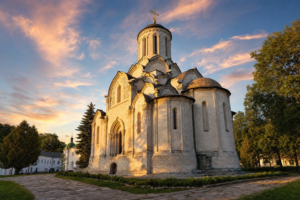
Most monasteries in Russia have two founding dates. The second, most often, falls in our time, when churches began to return property taken after the revolution. The first one’s different. Some monasteries have a long history, others have only a few decades.
Tikhonovsky monastery was considered young. It was founded in the middle of the 19th century on a place that Saint Tikhon Zadonsky loved very much. He often prayed here, even dug a well to quench his thirst. After the death of Tikhon, in 1783, the people began to use water from the well as healing. According to legend, many received relief from illness.
Not far from the well, the monks of the Bogoroditsky monastery equipped an apiary. This quiet, secluded place attracted many of the brethren, and they begged the blessing of the abbot for the forest silence. Therefore, by the middle of the 19th century, it was decided to arrange a hermitage on the site.
First of all, they put a wooden temple, dedicated to the saint of God Tikhon. There were cells for the brethren. Officially, the Tikhonovsky Monastery was opened in 1873.

At the expense of a local landowner, a former godless man who believed after a conversation with the rector of the Bogoroditsky monastery, Vasily Voeikov was built:
cathedral
Bell tower
New cells for the brethren
Business buildings.
At the monastery there were many workshops: icon painting, carpentry, sewing, shoemaking. The monks tended the garden, the apiary.
Everything was fine, but 1917 came. The new government did not have time to look around, but a decree was already issued on the separation of the church from the state and the nationalization of property. In 1919, a company began to open the graves of saints of the Russian Orthodox Church. In 1921 the monastery was closed. Nothing better than opening a children’s colony in its premises, the authorities did not come up with.
The monastery also suffered during the war. The bell tower, which stood all these years, was dismantled so as not to serve as a guide for enemy pilots. The walls of the buildings were dotted with fragments from shells, around the monastery there were many funnels from land mines.

After the war, the territory was used as a neuropsychiatric clinic. The buildings were rebuilt and abandoned.
The holy spring, the well, was poured with concrete several times, but the life-giving water broke through its thickness.
In 1991, when the restoration of the monastery (already female) began, the spring was first built. We put a new log and chapel, built a font, cleared the road.
Then they began to restore the cathedral. Already in 1993 the Trinity Cathedral was consecrated. A year later, the bell tower was restored and decorated with a high (11 m) spire with a cross.
To plunge into the spring, drink healing water, pray before the icon of the Mother of God of Iberia, with a bleeding crucifix, thousands of pilgrims come to the monastery.
Charitable Foundation Holy Land
Russian Temples and Monasteries