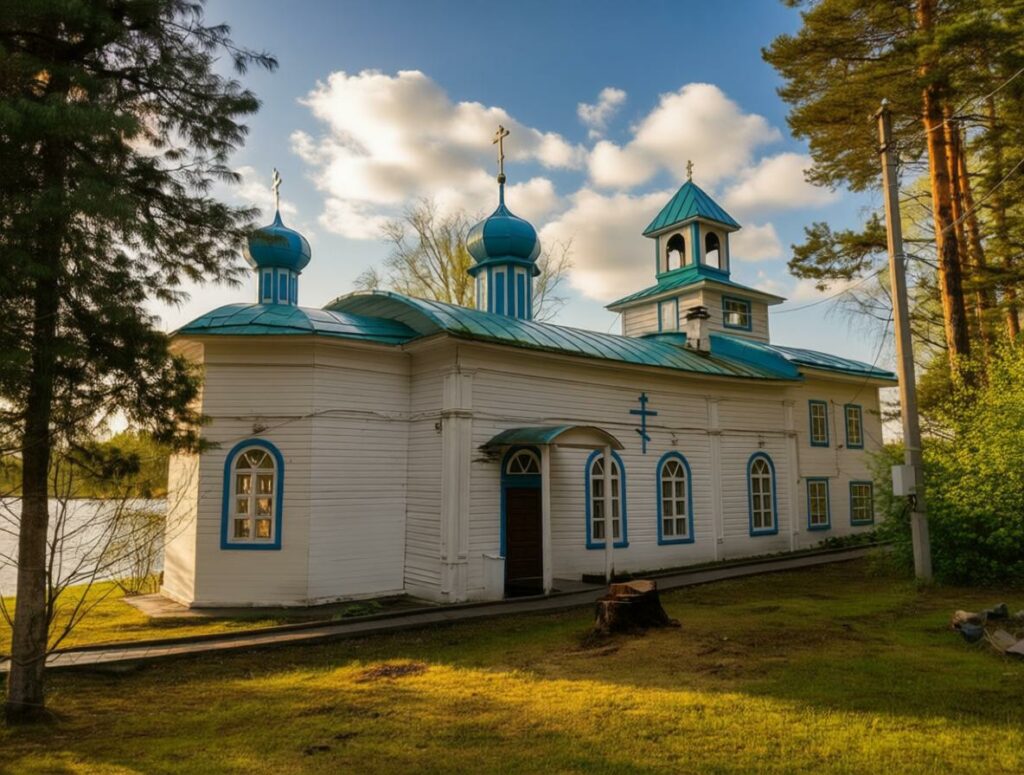
Eight kilometers separate the center of Verkhoturye from the place where the noise of the city finally dies. Here, on the left bank of the Aktai River, near the village of Privozalny, time seems to turn into a ring. Recreation house, children’s camp, then silence again. And in the middle of all this is a wooden log house with a gate over which a golden cross shines.
It looks like an ordinary village chapel. But the queue does not run out for years. People come here for one thing: to collect water or plunge headlong into the fonts, hoping that the body will let go of the pain.
There was no temple or temple here. Only the path along which pilgrims from different provinces went to Verkhotursky monastery. The road to the relics of Simeon Verkhotursky was exhausting to the limit. And the only salvation was the spring, hitting directly into the river. Travelers fell to their knees, drank ice water and found the strength to move on. Those who came with a sick body left almost healthy.
Word spread faster than it could walk. The monks noticed the place was working. In the middle of the XIX century, the land here was officially assigned to the monastery, and a loan appeared on the shore. Several inhabitants harvested hay and firewood, but the main thing was another – the flow of people did not stop. We had to build not just a chapel over the spring, but a whole inn.
By the end of the century, the wooden chapel had become a temple. It was named after the icon “Living Spring”. The name turned out to be accurate: water didn’t just quench thirst – it was followed specifically to heal.
After the revolution, the shrine was fully received. The church was closed, and the building was given for the needs of a new life. It was a club first. Then a hospital for the wounded. Historical irony: even when soldiers’ beds stood on the site of the altar, people continued to draw water from the spring. Nurses quietly, not advertised anywhere, noticed: those who drink from the Aktai key, wounds heal faster, and the fever subsides more easily.
Later there was a children’s health camp. The children ran through the grounds where monks once read psalms and had no idea they were running through the holy land. But the source kept hitting. Through Soviet power, through changing signs, through oblivion.
In 2002, everything fell into place. The temple was returned to the monastery, re-consecrated. Skit Oktay again became a compound of the Verkhotursky Nikolsky Monastery. And in 2005, a chapel-bath with a golden cross was built over the old well.
Now anyone can go down to the closed font. Inside is silence, reflected light and water that doesn’t smell like chlorine. It is said that Aktoy waters beat from such a deep layer that they do not have time to cool even in the strongest frosts.
You can dive all year round. The effect, according to experienced, is the same: first — shock from the cold, after a second — heat spilling over the bones, and then — a strange lightness, as if he threw off a heavy backpack that dragged his whole life.
You don’t have to be a saint to feel the power of this place. It is enough to come to the village of Privozalny, go to the Aktai River and stand at a wooden log house. No one will preach to you and ask for money. Just dial the bucket. Put your hands in him. And listen to what your body says.
The water remembers everything: those tired pilgrims, and wounded soldiers, and children from the camp who ran here without knowing it. She’s the only one. And he says to everyone who decided to dive.
Charity FundHoly Land.
Russian Temples and Monasteries