Imagine the end of winter in 1999. Two women make their way through snowdrifts to the ruins that were once the pearl of these lands. Around there is silence, broken only by the creak of snow, and before my eyes there are temples that have grown into the ground almost through the windows, vaults with gaping holes and walls pierced by car openings. Everything seemed to be over here. But it was from this visit that the story of a new miracle began — the revival of the ancient monastery.
The foundation of the monastery dates back to the XV century and is directly connected with a fateful event for the whole of Russia – the Great Standing on the Ugra River. Prince Dmitry Fedorovich Vorotynsky, who owned these lands, decided to perpetuate the memory of the day when the country was freed from the Horde yoke. The place was chosen not by chance: the people said that nearby, in the area of the present village of Spas, there was a Tatar camp. The first inhabitant of the monastery, according to legend, was a disciple of St. Tikhon of Kaluga — St. Nikephoros of Medina.
For many centuries the monastery lived thanks to the generosity of noble families: Vorotynsky, Streshnev, Turgenev. However, after the secularization reform of the XVIII century, the monastery was abolished, turning its churches into ordinary parish churches. The most difficult time came in the 1930s: the bells were silent, the ancient cemetery with unique tombstones was erased from the face of the earth, and property was ravaged. Even having received protection status in Soviet times, the buildings continued to decay.
When the ruins were handed over to the Church at the beginning of Zero, specialists had to work titanicly. In the Transfiguration Church there was a gap in the tent, and the walls went cracked. The Vvedensky temple did not have a roof at all — rain and snow destroyed the arches of the refectory. During the years of desolation, the buildings “sunk” in the ground by almost a meter, distorting their once elegant proportions. The first years of restoration resembled a partisan sortie rather than planned work: the sisters took out tons of garbage with their own hands, cut down nettles and elderberry thickets, plugged holes in the vaults with bags of hay.
The turning point came in 2005, when the monastery was officially transferred to the Kaluga diocese. There was public funding and, more importantly, people ready to breathe life into the ancient stones. Two years later, in 2007, the monastery was revived in a new status — as a female hermitage.
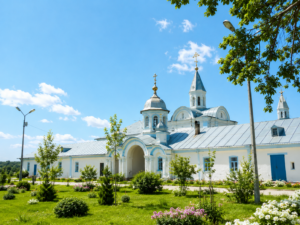
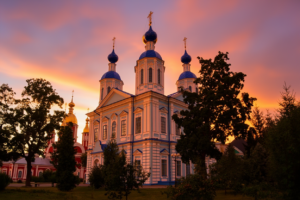
Today, looking at the well-groomed walls and golden domes, it is hard to believe that a couple of decades ago there was desolation. The main wonder of this place, perhaps, not only in its ancient history, associated with the independence of Russia, but also in the strength of spirit that prevented it from disappearing forever. Now the bells are ringing again here, and the silence broken only by prayer reminds us that even out of the saddest desolation a resurrection is possible.
Charity FundHoly Land.
Russian Temples and Monasteries