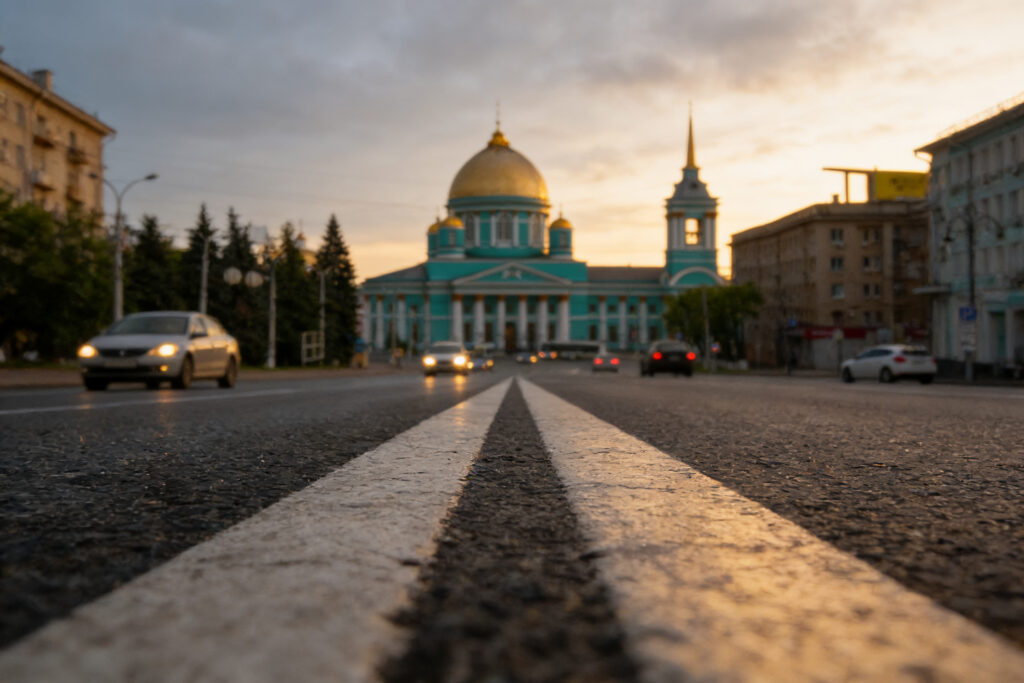
Kursk is famous for its history, but not one building does not have such a chronicle full of landmark dates and unusual events as the Znamensky Cathedral.
In the 17th century, the Kuryan saved the intercession of the Virgin from the Polish-Lithuanian invaders. In gratitude, the residents promised to build a monastery. We kept our promise. On the place that is now occupied by the cathedral, in 1615 the Church of the Nativity of the Virgin was erected.
After 15 years, the whole monastery burned down in a huge fire.
On the site of the burned-out built a new cathedral, already stone. And from Moscow brought the miraculous icon of the Virgin “The Sign”. The cathedral stood for almost 200 years, but began to collapse before our eyes.
In 1815, the building was dismantled, and a new temple was built on that site.
On January 13, 1826, the cathedral was consecrated. And after 3 days, the body of Emperor Alexander I was exhibited there for farewell, on the way from Taganrog to Moscow.
The Russian tsars did not leave the cathedral at all. The building permit was given by the first Romanov, Mikhail. The Sign handed over to Kursk the Second Romanov, Alexei.
The third generation of the Romanovs, John, Peter and Sophia, donated a huge bell that faithfully served 300 years and then cracked. But it was not melted down, but preserved, put on the site of the monastery.
Alexander I visited the cathedral 3 times during his lifetime, Alexander II, the last king of the Romanov family, visited here.
On the night of 1898, the monks awoke to the sound of a violent explosion. When the monks entered the church, it was covered with debris. But the icon “The Sign”, to the indescribable joy of the brethren, did not suffer. She remained in the temple until, retreating with the White Guard troops, she was taken abroad. Traveling around the world, the icon in the mid-50s of the last century was not far from New York. There she stays in the Orthodox church, on the courtyard, which was called the New Root Desert.
After the revolution, the monastery was closed, and in 1932 the temple was closed. A cinema was organized in the cathedral. In 1943, it burned out badly. In the post-war period there was a production facility. The building was then renovated and the cinema reopened.
Only in 1992 the premises were returned to the ROC. For a long time, worship was conducted right in the middle of construction work. The amount of recovery has been enormous.
But the enthusiasm was great. Especially when in 1993, miraculously, the list from the icon of the Virgin “The Sign” returned to the cathedral. It was performed in the icon-painting workshop of the monastery at the very beginning of the 20th century. For many years, the parishioners kept the icon secret.
The tradition of holding a procession to the Root Desert has also returned. On the ninth Friday of each year, after the Passover of Christ, the icon goes to the desert, where it stays until the Nativity of the Virgin, when again by procession, it returns back.
Only at the beginning of the two thousandth, the cathedral regained its former appearance. In 2003, 11 bells of the new bell tower rang over the city. The most massive bell weighs 13 centners.
The cathedral is now fully restored. Every day it is visited by dozens of pilgrims who come specially to pray at the image of Our Lady “The Sign”.
Charitable Foundation Holy Land
Russian Temples and Monasteries