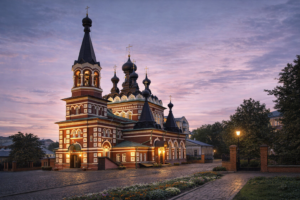
80 kilometers from Moscow, on a hill near the town of Khotkov, settled 2 brothers, Bartholomew and Stefan. They prayed and praised the Lord. After some time Stefan joined the brethren in the Moscow monastery, and Bartholomew stayed. He accepted monasticism
Sergius, who would later be called Radonezh. In the desert began to settle other inhabitants. Together, the brethren laid a small church in honor of the Holy Trinity. In 1340 the desert became a monastery. Thus began the history of the most famous monastery of Russia – the Trinity-Sergius Lavra.
No monastery has played such a role in the history of the country as this one. From here Saint Sergius blessed our army for the battle with Khan Mamay. The monks of this monastery turned the tide in the battle to the side of the Russian army. Here they baptized heirs, first the great princes, and then the kings.
The brethren of the monastery became an example of boundless courage, having withstood 16 months of siege by Polish troops during the Time of Troubles.
During the Strelets riot, the children of Tsar Alexei Mikhailovich sheltered behind the walls of the monastery: Sofia, Ivan and Peter.
How the laurel was built
Over the centuries, the monastery flourished, then faded, but the monastery steadily expanded.
To the Trinity Church during the life of Sergius, the church of Dmitry Solunsky was added. Then the monastery was surrounded by a fence.
15th and 16th centuries
In 1423 the Trinity Cathedral was built. It was the first stone building in the monastery.
Icons and frescoes for the temple were performed by Andrei Rublev and Danila Black. It is here that the famous “Trinity” by Andrei Rublev is located. Only a small fragment of the wall painting remains.
On the site of the first Trinity Church in 1477, Dukhovskaya was built. For this, from Pskov, Grand Duke Vasily III wrote out famous masters. The building is very reminiscent of the Trinity Church, but Pskov masters made an innovation: they took a place under the bells. Bell ringing was made on the mansion, in Pskov, from the ground. In addition to the church bells on the belfry there was a “flapping” bell, which was beaten in case of danger.
By order of Ivan the Terrible, in 1559 the construction of the Assumption Cathedral began. It was intermittent. The temple was consecrated only in 1585. The main shrine of the church is a wooden coffin in which the relics of Sergius of Radonezh lay before they were transferred to a silver rakka.
The murals on the walls have survived, some under a layer of late renovations.
17th century
Severely damaged during the Polish invasion, the monastery was quickly restored. Rich donations allowed to expand and decorate the monastery.
In 1623 the church of Nikon of Radonezh was built. It was built on the foundation of an earlier structure above the tomb of the saint.
The decoration of the church has not survived. The iconostasis and cancer of St. Nikon were made in the middle of the 20th century. From ancient times, only small fragments of frescoes remain.
In 1637, through the efforts of Celar Alexander, the Hospital Church was built in honor of Savvatius and Zosima Solovetsky. This is the only tent church of the Lavra. Although the iconostasis of the church is modern, it has an ancient icon of saints to which the church is dedicated.
In 1692 the Refectory Church was consecrated. It was dedicated to Sergius of Radonezh, whose 300th anniversary was celebrated that year. Important decrees were read from the porch of this church, the leaders welcomed the people, and the church hierarchs gave blessings. The view of the church resembles
A magnificent palace. It is richly decorated outside and inside. The magnificent iconostasis was dismantled in 1919. After the temple was reopened, an iconostasis was installed there from the Church of Nicholas the Wonderworker in Moscow.
6 years, from 1693 to 1699 built the Church of the Nativity of John the Forerunner. This gate church was first five-headed, then 4, in 1806, the chapters were removed. The original appearance of the temple was returned in 1974.
The ancient walls have not been preserved. During the restoration, the frescoes of 1872 were restored.
18th century
During the reign of Peter I, construction work was suspended. While Peter cut through the window to Europe, it was forbidden to build stone buildings. The successors of Peter the Monastery are not
They were interested, and only when Elizabeth Petrovna ascended the throne did the monastery come to life again.
The Queen loved the monastery, often came here not only to pray, but also to have fun. To do this, a palace was built next to the monastery, with a park and greenhouses.
By order of the Empress, a theological seminary was opened at the monastery. It’s with the abode.
became Lavra.
The St. Michael’s Church appeared in the Lavra in 1734. The relics of the saint are underground, and in the temple there is a cancer with his image. The iconostasis is small, from the house church of the Moscow Metropolitan. Painting on the walls was made in the 19th century.
We built a new bell tower for almost 30 years. Construction was completed in 1770. It surpassed in height (88 m) all the bell towers of Russia. Especially for her made not only bells, but also clocks with chimes.
In 1920, the Lavra was closed. After 26 years, a gradual revival of the monastery began. After the restoration, temples began to open, regular services resumed. The Lavra served as the venue for 3 local councils, here was the residence of the Patriarch.
It is now the most visited monastery. From all over the world pilgrims come here to venerate the holy relics, pray at the miraculous icons and feel the sanctity of this place.
Charitable Foundation Holy Land
Russian Temples and Monasteries