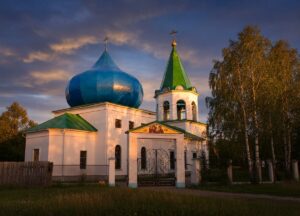
Imagine: noisy Moscow, a horde of shopping rows, and somewhere nearby, in Luzhniki, smells of fresh wood. 1460. It was then in the annals flashed the first modest record of a small wooden temple. Few people know, but the name “in the Archers” could be born not from the flood meadows, but from the ringing of the string – masters settled here, bent deadly battle bows. However, there is a more peaceful version: the place was famous for trading ordinary onions. Be that as it may, it was here, under the patronage of St. George the Victorious, that the life of the future shrine began to pulsate.
Stone heart instead of wooden beat here in the XVII century. In 1657, the “Building Book” for the first time recorded a good stone church. But the true transformation happened at the end of the century thanks to the ambitions of the merchant Gavrila Nikitich Romanov. Not just a temple, it builds a two-story splendor. At the bottom, as if ingrown into the ground, is the heavy altar of St. George, and at the top, in the streams of light, is an elegant Annunciation chapel. Connected them gallery-guild, under which today you can walk, touching the palm of rough white stone of the old staircase. The main audacity of the architect, whose name, alas, was erased, was the bell tower. Her tent, which covered the umbrella vault, became the first in Moscow design of such courage — a real architectural breakthrough.
The fate of the temple is a series of fires and revivals. In the flames of 1812 he burned, but did not burn to the ground, as if protected by his heavenly warrior. And by the middle of the XIX century, with the active participation of merchants Sadomov and Mazurina, the building acquired a familiar appearance. The gallery was dismantled, adding two symmetrical chapels, as if giving the temple to straighten its shoulders.
But the worst wounds were inflicted by the twentieth century. In 1932, the NKVD settled here. The tent of the bell tower and the domes were ruthlessly cut, cracks from the factory machines of the shoe workshop shone in the walls, and a cargo elevator and toilets were arranged inside. For half a century, the building died, turning into an emergency skeleton in which passers-by could not identify the House of God. Revival did not begin until 1993.
Today, it’s a place of power again. Saint Alexy Mechev served here, and the last rector, Archpriest Vladimir Proferansov, who refused to cooperate with the NKVD, was shot at the Butovo training ground. His memory is especially honored here, and in the restored northern aisle they now pray to him, the holy martyr. The temple comes to life not only with stone, but also with deeds: there is a parish service here, where everyone can get help without bureaucracy, and the chime of the bells now floats again over the old streets, reminding that real strength is measured not by centuries, but by faith.
Charity FundHoly Land.
Russian Temples and Monasteries