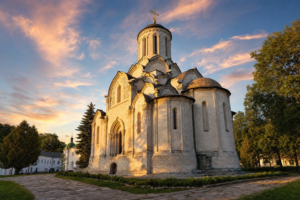
Stand on the left bank of Izhora, where it merges with the Neva. Close your eyes. 1240: Here Prince Alexander and his squad defeated the Swedish army. A victory that changed the course of Russian history.
Almost 500 years later, under Peter I, a wooden temple was erected on this legendary site. But the fire was stronger — he devoured the church twice: in 1726 and in 1797. Then the local residents of Ust-Izhora, not wisely crafty, leaned on the stone. And in 1799, a strict classical temple grew on the shore. Whose hand created the project is unknown, but its fate is known.
In the XIX century, the church overgrown refectory, bell tower and side chapels. And in 1934 it was closed: a club, then a warehouse. But the most dramatic moment came at the beginning of the siege of Leningrad. Soviet sappers themselves blew up the bell tower — too good a reference point for German artillery. Sacrifice to save the city.
In 1990, the temple was returned to believers. After the restoration, it again shone with a dome. Now children’s laughter rings here on Sundays — there is a school for children and adults, and the library smells of old lives. Nearby, in a quiet cemetery, in 2003 stood bronze Prince Alexander. Looking at Neva. Looks to eternity.
There’s a soldier temple on the shore. He did. So is Russia.
Charity FundHoly Land.
Russian Temples and Monasteries