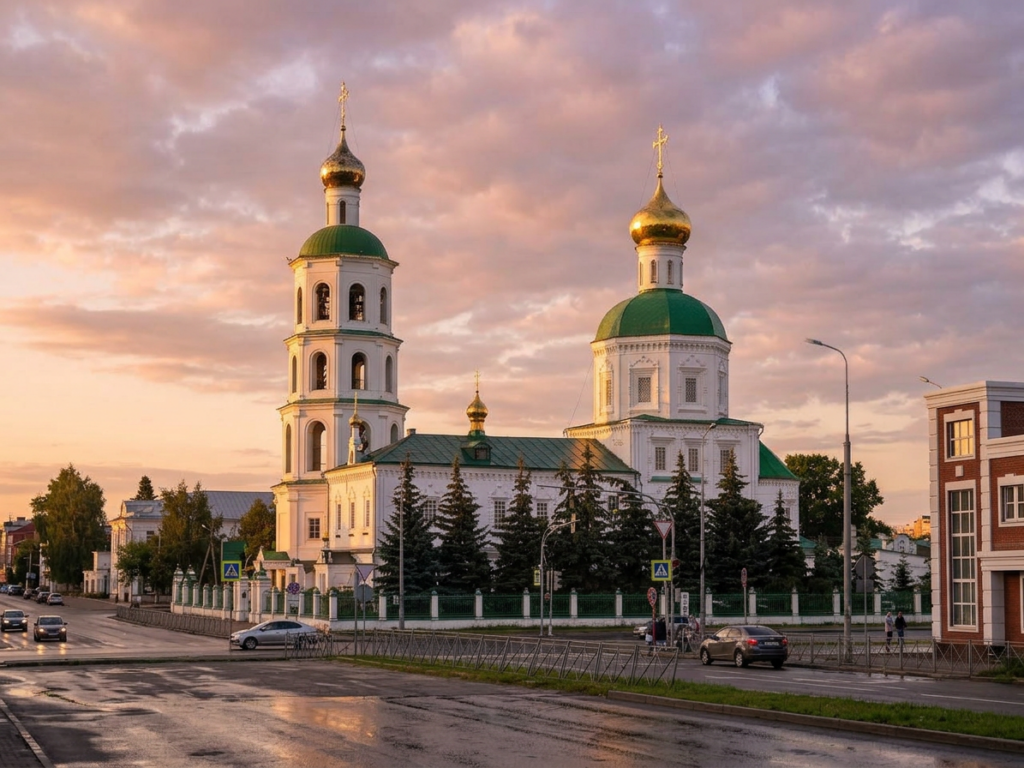
A striking example of 18th-century architecture, the Resurrection Cathedral amazed with its stone lace, beautiful decoration and rich decoration.
The architectural type is an octagon on a quadrangle, which is completed by a dome with a light drum. Inside, the walls were painted with scenes from biblical themes. The iconostasis was traditional, with five tiers. It was framed by wooden carvings. The shrines of the temple were the icons of the Iveron and Kazan Mother of God. The parishioners especially revered the unusual stone icon in a silver and gilded robe. It was transferred to the temple by Ivan Pchelin. The figures of St. George the Victorious and St. Nicholas the Ugodnik are carved on the stone base. The image was locally revered and participated in the religious procession, along with the icon of the Mother of God of Kazan.
Traditionally, the temple was considered a merchant temple. It was built at the expense of the merchant Ivan Andreevich Pchelin, and after that, the merchant class always allocated donations for the decoration, repair of the temple or its educational activities.
The cathedral survived the Red Terror of the 20s, but in 1938 it was still closed.
The premises were used as a beer warehouse, a radio station, and an art studio workshop.
The bell tower was destroyed, the walls were dilapidated.
In 1992, the temple was returned to the Russian Orthodox Church. Repairs were immediately carried out there and services began in 1995. In 2009, the bell tower was restored. From 1993 to 2016 it was the cathedral of the Mari diocese. Afterwards, this status was transferred to the Church of the Annunciation.
Now the temple rises above the surrounding area, attracting attention with its white walls and green domes. Services are held there daily.
Charity FundHoly Land
Temples and Monasteries of Russia