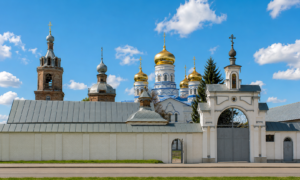
The Karelian archipelago welcomes guests in different ways. For some — the damp wind from Ladoga, for others — the silence of the pine rocks. But almost everyone who gets to the central estate of the monastery on foot stops at the same place: at the white church built right into the monastery wall. Stop. Here it is.
The Gate Church is not just an architectural element of the ensemble. This is the threshold. By crossing it, a person officially finds himself on the territory of the monastery. And the very fact that a temple has stood above this threshold since the beginning of the 19th century says a lot: there is nothing accidental here. Stone on top of stone.
Construction was completed in 1809. The architects used a technique that was rare for that era — they combined the pre-Petrine tradition of gate churches with classicist details that were then in fashion. It turned out harmoniously: the arched vaults breathe antiquity, and the proportions of the facade are precise, almost St. Petersburg.
In the middle of the 20th century, the fate of the building changed dramatically. When the monastery was empty and a military school settled on the island, the church decoration was dismantled without ceremony.
The gilded details of the iconostasis went on stage — literally. One of the monks, who secretly visited the island in 1941, described what he saw with undisguised pain. Later, the premises were given over to the economic needs of the district hospital.
Mosaic outside, silence inside The facades of the church are decorated with mosaic images — bright, large, clearly visible even from afar. On the main facade there are figures of the founders of the monastery and the Apostle Andrew; on the reverse side — Nicholas the Wonderworker, patron of wanderers, and both apostles, in whose honor the temple was consecrated. Directly above the arched passage is the Iveron Icon, which people have long called the Goalkeeper.
Inside is a completely different matter. No pomp. Granite, wood, natural light.
The iconostasis was recreated, but the craftsmen relied on surviving fragments of the historical — the connection with the past was preserved, albeit in a small way.
After a long silence. The restoration took several years. In 2018, Patriarch Kirill consecrated the temple, and the temple returned to its original purpose. Now the liturgy is served here. Tourists inspect the building from the outside, and pilgrims go inside for services.
It is noteworthy that in the period between Soviet desolation and current church life, the temple managed to become a concert hall and exhibition space — the choir of the Valaam Monastery performed here for the first time, which later became famous far beyond the island.
Charity FoundationHoly Land
Temples and Monasteries of Russia