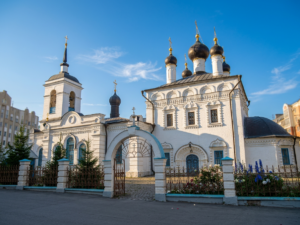
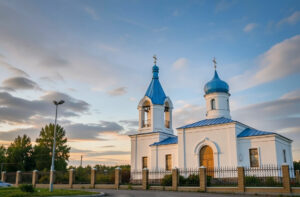
The village of Elokhovo is ancient, existed even in the time of Dmitry Donskoy. By the end of the 17th century, a church was built here, and in the early 18th it was rebuilt. The brick was granted by Peter 1, and the funds were given by Princess Praskovya Ivanovna, the niece of the tsar. The church was rebuilt continuously. The number of parishioners was constantly growing. At the end of the 18th century, the family of Sergey Lvovich Pushkin joined them. In 1799 he baptized his son Alexander in this cathedral. The ceremony took place in the refectory, which has survived to this day.
In 1837 it became clear that the old church could not accommodate all the parishioners and it was dismantled. The construction of a new cathedral was entrusted to Evgraf Tyurin. He had already built churches. The Church of St. Tatiana MSU is his project. In 1845, the construction was completed, but it took another 8 years to complete the interior decoration. Only in 1853 the church was consecrated.
Oddly enough, after the coup of 1917, services in the cathedral continued, although there were attempts to close it. In 1935, a decree was issued to open a cinema in the church building. But just at this time the patriarchal cathedral that was in Dorogomilov was destroyed. Metropolitan Sergius, who was responsible for the patriarchal throne, moved the see here. The authorities did not resign, just postponed the closure.
War
On June 21, 1941, Father Nikolai Kolchinsky served all night. After the end of the service, he announced that tomorrow morning he would serve the last Liturgy, and then the church would be closed. The next morning, parishioners waited for officials to arrive, but no one showed up. A little later on the radio announced the beginning of the war.
It was from the pulpit of this cathedral that Metropolitan Sergius blessed all Orthodox “to defend the sacred borders of our homeland.”
On June 26, defense funds were raised in the temple. An example was given by the Metropolitan. He gave the cross from the klobuk and the chest cross for the needs of the country.
300,000 rubles were raised in January and another 250,000 in February.
An anti-aircraft point was equipped at the bell tower, the bells were removed and moved to the altar.
In the autumn of 1941 the situation at the front became critical. The order was given to mine all important capital objects and, in case of capture of Moscow by the enemy, to blow them up. The leadership feared that if this happened, the Nazis would arrange solemn services in the temples of the city. Some of them were also mined to prevent this. Among them was the Epiphany Council. The situation at the front changed by winter, in February the mines were removed.
On February 22, 1942, in a 20-degree frost, thousands of people gathered in the unheated cathedral for a prayer service for the granting of victory.
During the war, the feelings of believers were on such an upsurge that people received communion daily, the service ran from 6 a.m. to 5 p.m.
In 1943, for the first time in years, a patriarch was elected in Russia. It was Metropolitan Sergius. The Epiphany Cathedral held a solemn service on the occasion of his erection to the throne. When, in 1945, he died, Metropolitan Alexy was elected Patriarch. He officially decreed that the Epiphany Council becomes patriarchal. In 1992, the cathedral again became a cathedral, and the title of patriarch passes to Uspensky.
Shrines
The first icon to return to the temple was a list from the image of the Kazan Mother of God. Before that, he was in the Kazan Cathedral.
It also houses the relics of Saint Alexis, a wonderworker who lived in the 14th century. His relics were kept in the Chudov Monastery, then the Archangel Church of the Kremlin. In 1947, they were placed in a specially made crayfish and moved to the Epiphany Church. The order was given by Stalin, after the urgent request of the Patriarch.
Orthodox pilgrims strive to the temple to worship: a particle of the Tree of the life-giving cross of the Lord and particles of the relics of Nicholas the Wonderworker. Here come to reflect on the relics of Metropolitan St. Peter, the head of John Chrysostom, the right hand of Andrew the First-Called. Pray before the image of the Mother of God “Joy to all who mourn.”
Icons of the Mother of God “The Redeemer”, “Tenderance”, “The Recovery of the Dead”, particles of Seraphim of Sarov’s clothes, the image of the Monk, the banner of the 19th century, created in honor of the coronation of St. Nicholas II – it is simply impossible to describe all the shrines of the cathedral. Each salary, carved decoration is a story about a certain event, an indestructible bond between generations of Orthodox believers.
Charitable Foundation Holy Land
Russian Temples and Monasteries