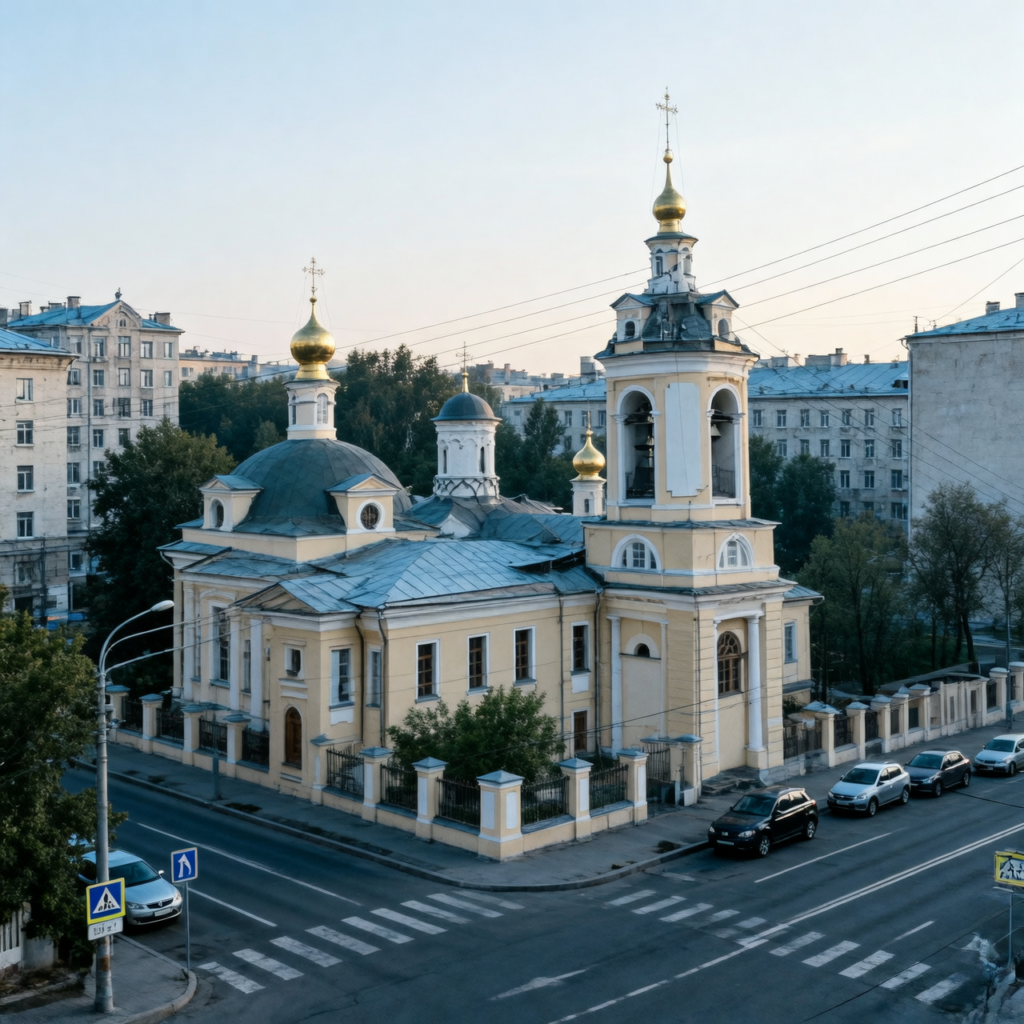
Imagine: a narrow Moscow alley, a shadow from the walls of the future Pushkin Museum, and a small temple that remembers the ringing of the royal pegs and the hot whispering of the prayers of the oprichniki. This is the Church of the Hieromartyr Antipas of Pergamon, a place where history speaks not in dates but in voices.
The fate of the temple from the very beginning intertwined with the sovereign Kolymazhny courtyard, where the departures of the Moscow tsars were guarded. Back in 1514, Aleviz Fryazin erected a wooden church here for the grand ducal stables. But the real stone temple, which came down to us, rose later — in the stormy 1560s. And here on the stage comes a figure from which contemporaries had cold blood: Malyut Skuratov. Adjacent to the church, the Skuratov estate and a tiny chapel of Gregory Decapolit, the heavenly patron of Malyuta, in the baptism of Gregory, give the customer with his head. For a long time in Moscow believed that the formidable oprichnik found the last shelter in the family crypt under these vaults.
The architectural appearance of the temple today is a real stone puzzle. Imagine an ancient cubic volume with a very rare two-apse part, on which the chapels have been layered for centuries: Nikolsky, Catherine, the Nativity of John the Forerunner. The parishioners here were loud Russian names — Apraksins, Lopukhins, Obolensky. And at the beginning of the XX century, Valentin Serov wandered nearby, working on the project of the future Museum of Fine Arts, which later the church will go on a long «museum» lease.
After closing in 1929, a completely different life flowed here: workshops of revolutionary artists, communal apartments, architectural offices. In the 1950s, the dome of the Nikolsky chapel was demolished, and later the stores of the Museum of Fine Arts were equipped within the walls of the temple. But in this museum pause, a miracle happened — a scientific restoration began, which preserved the monument.
Today the temple is amazing with its energy. In 2005, after 76 years of silence, the liturgy was again sung here on the feast day. Now it is not just a functioning church, but a living center of attraction, where evangelical conversations are broadcast live, the parish choir gathers from the parishioners themselves, and in the evenings the Antipas Book Club gathers in the refectory — without the obligatory «home», with a blind discussion. And it seems that the ancient walls, which saw Malyuta and Serov, finally found their main voice — the voice of a living community.
Charity FundHoly Land.
Russian Temples and Monasteries