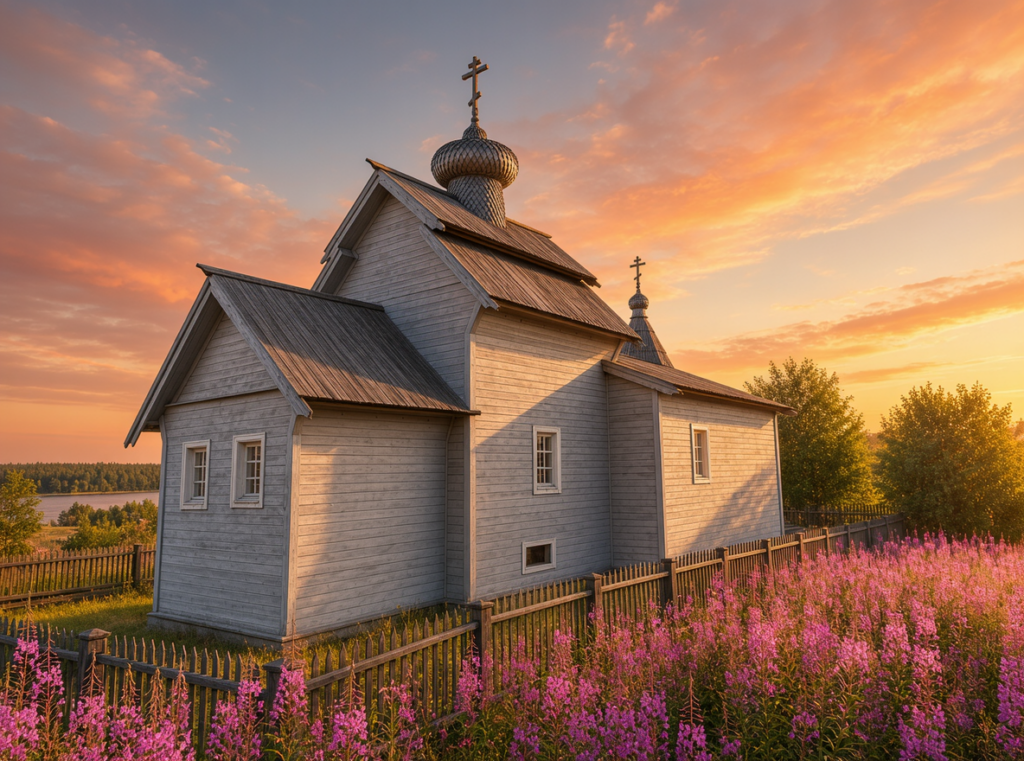
The south of the Murmansk region meets travelers not with drenched windy dampness, but with amazing calm. Here, in the ancient Pomeranian village of Kovda, time flows differently. It is not in a hurry, but as if frozen in the mighty log walls, remembering the cold of the White Sea and the blows of the axe masters who went down in history nameless. The main local attraction is not modern comfort, but the wooden St. Nicholas Church. It stands on the shore where the harsh nature of the north meets with human will, giving birth to monuments that have no equal in the whole Karelian Pomerania.
This place was a saint long before the current building took shape. The first records of the temple here date back as far as the XV century. That ancient predecessor has sunk into oblivion, and on its foundation in the early XVIII century carpenters built a new cage. However, even among scientists there is no consensus on the age of all parts of this structure. A spacious refectory, for example, could well stand here before the rest of the logs. Someone suggests that it was transported here from somewhere else, as if collecting a temple-designer from logs, each of which lived its own life before becoming part of the shrine.
When you get closer, you notice the main architectural cunning of the architects. The church seems higher than it really is. The secret lies in the bold decision: four raised, and gable roof made bunk. This composition is crowned by a massive drum with a three-dimensional head, which serves as a beacon for everyone who walks on water or land. Nearby, like a faithful guard, stands a tent bell tower built in 1705. Once there was no noise of the tracks, and the ringing spread for many kilometers, setting the rhythm of the life of the Pomeranian village.
But the fate of this monument is not a series of dry dates for repairs, but a real drama with elements of a detective. In the 1960s, the temple, like many others, was abandoned. People then spared him, did not disassemble for firewood, but time was ruthless. By the early 90s, the building was turning into a ruin. Restoration began, but the path to revival came out thorny. First, the front facades were removed from the cladding, which greatly weakened the building, and later the bell tower was reconstructed almost anew, causing controversy among specialists: how much does the new model correspond to the historical appearance?
However, the real sensation was waiting for researchers in 2004, when an ancient burial was found under the floor of the temple part. It wasn’t just a cemetery. Seventeen wooden decks stood neatly in the depression. Looking inside, scientists froze: there rested children wrapped in birch bark “savans”. What was that? The Old Believer tradition that went underground, or the desperate attempt of people to stop a terrible epidemic that claimed one child’s life after another? The mystery of the St. Nicholas Church is still not solved, attracting the attention of cultural scientists and anthropologists.
Today, the restoration is nearing completion. Surprisingly, the masters of the Pomorsky carpentry school managed to preserve almost 70 percent of the original material. This is a rare case for a building with such an impressive age. The ceilings were restored, the chapter shines again, and the porch of the XIX century again welcomes guests with a wide step.
The population of Kovda is now small, but life here warms up. And it is not only that the climate in the south of the region is milder than in Murmansk. People are waiting for the candles to light again in the temple. When the walls that remembered the fifteenth century, the mysterious burial, and the years of oblivion will finally have their rightful voice. In the meantime, this monument of wooden architecture remains for the traveler a rare opportunity to touch the authentic northern antiquity — not embellished, not museum-sterile, but real, with its pain, secrets and unique architectural smile.
Charity FundHoly Land.
Russian Temples and Monasteries