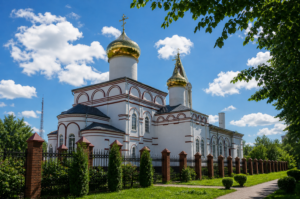
The construction of a temple is often associated with a miracle or unusual events. This is true for the church of Sergius of Radonezh in the village of Ivashchenkovo, now Chapaevsk.
First, construction time. Construction began in 1916, at the height of the war. In the west there are battles, devastation, a shortage of everything and everything, and in the Samara region, in a tiny village, a temple is being built, and even some.
Secondly, the architecture and decoration of the building. The church is built in Art Nouveau style. The cladding of the building is made of many materials, and even delivery during the war was poorly arranged.
It is a miracle that the construction was completed in 2 years. For finishing, tiles, facing tiles, majolica inserts were used. Materials were delivered from the Urals.
Thirdly, the temple was consecrated in 1918, already under the new government. This can also be attributed to wonderful events. At the peak of the struggle with the old order, a temple begins to operate in the working village.
Unfortunately, not for long. In 1926 the church building was requisitioned. In 1929, bells were removed from the belfry to cast a monument to Chapaev.
First, a defense house was organized in the building. For several years the building was abandoned.
A miracle happened here in 1948. In the village, with the speed of a forest fire, ran a rumor that overnight, all the remaining icons in the temple were updated. Even hardened atheists rushed to church to see for themselves that this was true. Despite attempts by the authorities to explain the
The renewal of icons, the secret actions of the clergy, no one believed them. In order to prevent worship, the House of Pioneers was made in the building, and the icons were closed with wooden panels.
Fortunately, times have changed. The building of the church was recognized as an architectural monument of regional significance. In 1990, it was returned to the faithful. Here happened another miracle – the first priest in the temple was Father Sergius, a builder by training. Under his leadership, the parishioners themselves strengthened the foundation. Then the money for the restoration was allocated by the state. Over the interior decoration, masters from Syzran were invited to work. They painted the walls, designed the iconostasis.
Alas, the recovery from the outer wall was much more difficult. More than half of the jewelry and tiles are lost irretrievably. The secret of their manufacture is also unknown. Restorers have to look for a recipe for ceramics and glaze “to the touch”, and this greatly slows down the process.
The second problem is the lack of drawings. We have to rely on old photos, the quality of which leaves much to be desired.
Although the restoration is far from complete, the temple is already pleasing to the eye. This is the pride of Chapaevsk, his calling card.
Charitable Foundation Holy Land
Russian Temples and Monasteries