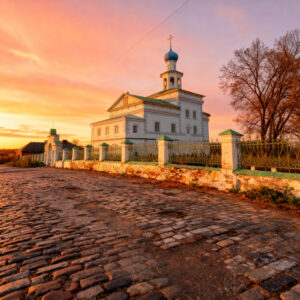
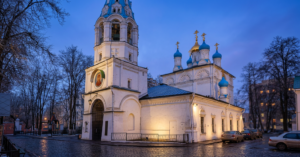
There are places that do not need advertising. You turn from a noisy street to Vishnyakov Lane — and here it is: squat, light, with a dome that seems to grow out of the Moscow roofs by itself. The Church of Nikola in the Kuznets does not shout about itself. It just stands, and that’s probably the most important thing you need to know about it. Blacksmiths appeared here under Ivan III — it was the sovereign masters, who were settled compactly, in a settlement. They forged, knocked hammers, and they needed their church not for beauty, but for life. The wooden building of the end of the XV century has not survived — burned or dilapidated, as it often happens. It was replaced by stone in 1683. But she did not resist the time: at the beginning of the XIX century, parishioners decided to build the church anew — on conscience, with a scale.
The new church received a dome-rotunda – a rarity for parish churches in Moscow. It was consecrated in 1817, when Moscow had not yet recovered from the consequences of the Napoleonic fire. Perhaps that is why the celebration was special: the city was being rebuilt, and each new dome above the horizon seemed a sign of rebirth.
Thirty years later, the church was transformed again. By 1847, a new bell tower was built, and most importantly, a spacious refectory with three chapels. The northern chapel was first consecrated in honor
Hieromartyr Basil of Amasia, but then Metropolitan Philaret re-sanctified him in honor of
An introduction to the temple of the Most Holy Mother of God. It would seem that the change of initiation is a decided matter. But the parish judged differently: Basil of Amasius is still considered the patron saint of the temple. Tradition is a stubborn thing.
The five-tier iconostasis of the main altar was installed after all the reconstructions under the project of 1853. It still stands in its place – massive, proportionate, without unnecessary gilding.
But the main test lay ahead. After 1917, churches were closed one after another — for clubs, granaries, workshops. Nikola’s church in Kuznets was not closed. For what reason is history silent? But another thing is known: worship here did not stop all the decades of Soviet power. This makes the church exceptional even against the backdrop of the few surviving Moscow churches.
She’s living a full life today. Since 1992, the heart of the Orthodox St. Tikhonov Humanitarian University has been beating here. Students-theologians, parishioners, occasional guests – they all enter under the same dome, which saw blacksmiths five hundred years ago.
Some places store time. Nikola-on-Kulishki is one of those places.
Charity FundHoly Land.
Russian Temples and Monasteries